
IIMA Leverage 2009 concludes:A diary of an enthusiastic participant
February 09, 2009
IIMA Leverage 2009 concludes:A diary of an enthusiastic participant
Ahmedabad, DeshGujarat, 9 February, 2009
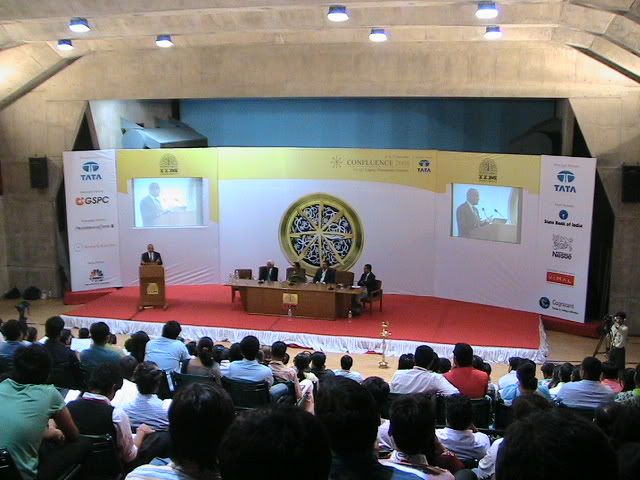
IIMA Leverage 2009, Day1
IIMA’s Leverage 2009: The Private Equity and Venture Capitalists conference began today with House-full “Mentoring Café” sessions organized by the esteemed faculty of IIMA. The sessions were held specially for entrepreneurs and were conducted by Prof. Raghuram (Services, Logistics &Operations), Prof. P. K. Sinha (Strategy & Marketing)and Prof. Ajay Pandey (Strategy & Finance).
The sessions were quite interactive as entrepreneurs asked questions ranging from value creation, service providing, financing to making a sales pitch. Prof. Raghuram commented that “there’s considerable opportunity to increase the service level at each point in the Indian context”. He talked about various ways in which basic services – courier delivery – and special services – call centers – can be improved to garner more customer satisfaction. Prof. PK Sinha commented that it is paramount that the values of customers be in sync with the value provided by the company. He said “business values have a limited life, but consumer values are eternal”. Prof. Pandey warned the entrepreneurs to not make a pure sales pitch to possible investors when showcasing a business plan. He said that overplaying the upsides and underplaying or ignoring the downsides forces the investor to carry due diligence and bear costs, thereby creating a bad impression of the entrepreneur. He also talked about the current market situation where funds have dried up, and commented that there are ways to counter it, which is certainly not easy.
The inaugural session of Leverage 2009 kicked off with the opening address by Prof B. H. Jajoo’s , Dean IIM-A. Prof. Jajoo applauded the efforts put in by students to organize the event and underlined the importance of entrepreneurship in the current economic turmoil. The event with theme “Venture Capital and Private Equity: Investing and Managing Portfolios in Distressed Times” consists of a business plan showcase event and high profile speaker series.
The inaugural session marked the release of the first magazine on Venture Capital and Private Equity, Leverage. Prof Jajoo highlighted the exponential growth of Private Equity in the last few years and the importance of an event like Leverage in the current economic uncertainty. Prof Rakesh Basant highlighted the role of CIIE and its activities which has the core idea of linking teaching, research and incubation. CIIE has been instrumental in supporting around 15 companies on the verticals of health, clean energy and information technology. Prof. Basant explained the organic linkages between CIIE and IIM A and the involvement of faculty and students with CIIE activities.
The first guest speaker of the day was Mr. Kanwal Rekhi. Mr. Rekhi, the cofounder of Inventus Capital, widely referred as “The Legend from Asia”, delivered a lecture on “Entrepreneurship in Hard Times”. Mr. Rekhi suggested that recession is the best time to be an entrepreneur. He explained that in current environment, jobs are scarce, resources are cheap. He clarified the misconception that funding is impossible in current scenario.
Mr. Rekhi encouraged the youth to lead from the front. He stated, “Society needs a fine balance of discipline and indiscipline, of stability and dynamism”, and then explained how entrepreneurs are essential, along with managers for the prosperity of overall society. The west, especially the US has enjoyed a very fine balance and thus exhibits a great potential for entrepreneurs and business managers.
Mr. Rekhi also hinted at the importance of innovation required to be a successful entrepreneur. He described his success story about how he, along with two other partners, developed innovations in TCP/IP connectivity to capture the huge market of distributed personal computers at Silicon Valley. After returning back to India, Mr. Rekhi realized the need to encourage entrepreneurs. He wanted to provide some help, develop role models, and create a platform for entrepreneurs to come forward. This led to the establishment of Inventus and the rest is history. He concluded by urging the youth to give themselves a chance to succeed. “It’s up to you to give yourself a chance, else no one would ever know, what you could achieve”, he said.
The second speaker for the day was Mr. Mohanjit Jolly, Executive Director of Draper Fisher Juvertson, India. He is an alumnus of Anderson School of Business Management, UCLA. He started off on a lighter note with taking a dig at VCs saying, “I will let you in on a secret. Most VCs would tell you in confidence that VC money is the last resort you should take after borrowing, begging and stealing; simply because VC money is very expensive!”Mr. Jolly shared nuggets of his experience from over thousands of pitches he has heard as a Venture Capitalist and emphasized on ten most common mistakes an entrepreneur should learn from and never make while presenting his/her proposal.
A common mistake budding entrepreneurs make, said Mr. Jolly, is believing there is no competition. He also said that young entrepreneurs very often complain that VC funding is a huge vicious cycle. Complaining is the last thing one should do, he said. One should embark onto building a credibility continuum. There were two important must-dos he recommended for impressing the VCs. First, you must have a very good team that can work well together and second, take the help of professionals when it comes to legal counsel, accounting and other such functions. “A divorce lawyer handling your company’s legals is a sure-fire red flag for any VC”, he said. He concluded saying that, “You should look infectious; the other person must think once that he is going to make it big”.
IIMA LEVERAGE 2009 – Day 2
Speaker – M. Damodaran (Ex-Chairman, SEBI)
The second day of Leverage 2009, the Venture Capital and Private Equity Conference of IIM-A began with an address by Mr. M. Damodaran, the ex-Chairman of SEBI, which focused on some of the key issues in Private Equity given the current economic slowdown. According to him, the increasing leverage in investments can’t be handled by smaller companies, and this leads to instability. Private Equity as an investment opportunity is available only to some players in the market, and this information asymmetry is bound to lead to destabilization of the markets. Further, according to him the varied roles that investors play, like investing in growth companies, may lead to conflicts of interest, further deepening the problem. While there is widespread belief that Private Equity brings in better Corporate Governance, Mr. Damodaran differed from that view by stating that there is ample evidence that disclosure levels do not always increase with Private Equity. The address was followed by a Q&A session, where Mr. Damodaran answered specific queries from the audience. When asked about whether audit reforms are needed, in the light of the Satyam fiasco, he responded by stating that what is needed is rotation of auditors in a phased manner, similar to Public Sector Banks to avoid familiarity with the management.
Speaker – Mahesh Murthy (Seed Fund)
Observing the challenges and opportunities that present themselves in today’s entrepreneurial aspirants: A successful entrepreneur’s perspective Mr. Murthy started off with the hope that his session at Leverage 2009 would be more of an interactive one, much like the informal efficiency he brings to his work. He first dealt with the relation between venture capitalism and entrepreneurs, rounding it off by saying “The most reliable way to be a venture capitalist is to first be an entrepreneur.” Moving on, he went to highlight the greater chances in Private Equity for young minds than embarking on Venture Capitalism right away.Mr. Murthy’s definition was “An entrepreneur is someone who is trying to find what is right for him/her”. He stressed on the importance of moving away from simple assimilation in order to realize what one needs to do in life. Highlighting his interactive nature he asked the participants about the origins of companies to point out the power of having a unique idea which so appeals to consumers that they become the brand ambassadors of the company, as a lot of the world’s best brands have achieved their visibility and ultimately their business through the simple word-of-mouth channel.
In his words, “The biggest thing you can do is have an offering which captures the minds of the customer. If you don’t have that, you can go back to the drawing board.”
He further iterated that every successful company has a sustainable policy of generating “insane consumer delight”, and that is all that is needed for a budding entrepreneur to make it big. He next went on to speak about the different abilities required for guiding different stages of a company, stating that there are very few people who can take a company from scratch to achieve a factor of 10. Therefore one should realize which stage he/she is best adapted for.
Mr. Murthy wrapped up his session by asking the budding leaders and entrepreneurs to be focused on what they want to be doing, but also to take time out and enjoy the years they have ahead of them. In his words “Don’t look for the end of the rainbow for your pot of gold, just live in the beauty of the rainbow itself.”
Speaker – Sandeep Singhal (Nexus Capital)
Sandeep Singhal is the co-founder of Nexus Capital, a venture capital firm that invests in companies located in India. Having done his MBA from the Wharton School, he is also the co-founder and MD of eVentures and is actively involved with TiE, Young Entrepreneurs Organization etc.
Today, he spoke about fund-raising and cash flow management, which are critical issues faced by budding entrepreneurs. Although he himself is a venture capitalist (VC), he warned entrepreneurs against seeking capital from outside unless absolutely necessary. In the presence of buffer capital, entrepreneurs tend to lose the sense of urgency and slack can creep into the business.
However, VCs could help with some necessary contacts and also play an advisory role that contributes towards the success of the business. The external funds can help the entrepreneur manage and mitigate the risk.
At a very early stage of the business, one could seek funds from angel investors or seed funds. Angel investors could additionally play the role of a mentor. VCs and private equity investors help in later stages of the business. Usually funds are provided in exchange of equity and the entrepreneur has to decide how much equity he is willing to part with. In order to decide how much funds to seek, an entrepreneur has to predict the future course of business, project its revenues and decide how much funds might be required.
He also felt that the chemistry between the entrepreneur and VC is very important. Unless they share the same vision, differences can creep in that can impede the growth of the business.
He ended by saying that management education plays a very important role in shaping successful entrepreneurs, especially in the Indian context as this gives them the valuable experience of being in a business environment even before starting the business.
Panel Discussion: Ajay Tandon (Citi Venture Capital), Amol Jain (Texas Pacific Group), Dhiraj Poddar (Standard Chartered PE), Suresh Raju (TVS Capital) and Utsav Baijal (Apollo). Moderated by Sandeep Singhal (Nexus Capital).
A panel discussion, moderated by Mr. Sandeep Singhal, brought together panel members belonging to firms spanning the gamut of the PE industry philosophy, from ‘worth more dead than alive’ buyout firms to growth funds. The panel members outlined their respective outlooks towards investing as a PE firm. They agreed that Indian industry would see some pain in the short term but remained confident of India’s long term growth potential. The differences in the entrepreneurship styles in India and abroad and how these lead to different PE investing styles were brought out. PE funding as ‘value-added capital’ was discussed along with the need for operating specialists in PE teams. The audience got to pick their brains through a short Q & A session. All the panel members, four of them alumni of IIM Ahmedabad, advised students to not look at ‘brand equity’ when looking for jobs, but to find what excited them. The panel members agreed that the recent Satyam debacle would make due diligence more pointed. They stressed on the need for work experience in other industries before joining PE as a career.
In his concluding address, the Director of IIM A, Prof. S. K. Barua, mentioned that he would have loved to attend every session of the two-day conference and lamented that since becoming an administrator he was only invited for the opening and closing ceremony. He praised the VC/PE industry as the new source of ‘patient’ capital for businesses and as the drivers of innovation and capital formation. He expressed his wish to make Leverage an annual event as IIM A’s contribution to this process of capital formation and to provide a forum for capital seekers and investors.
Also read
IIMA Confluence concludes: A diary of enthusiastic participant
🗃️ This story is from our archives and may contain outdated information.
Recent Stories
- Navsari Man Booked for Rape, Harassment, and Financial Exploitation of Hindu Female Employee
- Gujarat HC Pulls Up Yusuf Pathan for Occupying Public Plot Without Allotment, Warns of Costs
- 'Conman' Anil Vibhani Booked for ₹4.75 Crore Fraud in Kirtidan Gadhvi's Norat Nagari Garba Event
- ACB Gujarat Traps Municipality Clerk in Bribery Case
- ACB Gujarat Nabs Sarpanch's Husband, Aide in Rs 5 Lakh Bribery Case
- Ahmedabad School Van Fares Hiked by ₹200, Auto-Rickshaw Charges Up by ₹100