
PM invokes spirit of Team India ,Cooperative Federalism in CMs meet
December 07, 2014

New Delhi, 7 December 2014
The Prime Minister, Shri Narendra Modi, today gave a new thrust to the quest for an effective replacement to the Planning Commission, describing “Team India” as a combination of three teams – the Prime Minister and Chief Ministers; the Union Council of Ministers; and the bureaucracy in the Centre and States. He was delivering the opening remarks at a consultation meeting with Chief Ministers on the subject of replacement of the Planning Commission.
Invoking the spirit of “cooperative federalism”, the Prime Minister said that the current global scenario offered a chance for India to take a big leap forward. The Prime Minister called for abandoning the incremental approach. He stressed on the need for a suitable body to replace the Planning Commission, so that the strengths of the country can be suitably harnessed.
The Prime Minister said the question of role, relevance and restructuring of the Planning Commission had been repeatedly questioned for more than two decades. The first introspection was done after the launch of economic reforms, in 1992, when it was felt that in light of changing Government policy, a different approach was required. In 2012, the Parliamentary Consultative Committee stressed the need for a serious look at the Planning Commission and the need for a new body to replace it. The former Prime Minister, Dr. Manmohan Singh, had stressed the need for a relook at the Planning Commission towards the end of his term, Shri Narendra Modi added.
Further, the Prime Minister said that when he was Chief Minister of Gujarat, he had attended meetings of the Planning Commission, and had felt the need for a better platform to articulate the view of states. The Prime Minister said that development is now a priority for all, and the time has come to develop a new mechanism to deliver growth and development.
Shri Narendra Modi said it is impossible for the nation to develop unless states develop. He said the process of policy planning also has to change from “top to bottom” to “bottom to top.” The Prime Minister also noted that in countries such as the USA, thinktanks that function independently of the Government have a major role in policy-making. He said that in India too, there is a great deal of economic activity that happens outside the Government setup, and there is a need to design policies for them as well. He said that states should have a key role in the new body to replace the Planning Commission. He added that states sometimes feel there is no platform to express their views. He also said there should be an effective mechanism to address inter-state disputes.
“Can we develop a new mechanism, that plans according to India`s strengths, empowers states, and brings on board all economic activity, including that which happens outside the Government,” the Prime Minister asked, as he set the tone for the discussion in today`s consultation meeting. He said the views that states express in today`s meeting would prove valuable in shaping the new body to replace the Planning Commission.
PM’s concluding remarks at the consultation meeting with CMs on replacing the Planning Commission
The Prime Minister, Shri Narendra Modi, at the conclusion of the consultation meeting with Chief Ministers, said that the meeting was fruitful and all Chief Ministers had offered significant suggestions.
The Prime Minister referred to remarks made by Dr. Manmohan Singh on April 30th, 2014 regarding the Planning Commission. He said that Dr. Manmohan Singh, who had been associated for a long time with the Planning Commission, had noted that the body has no futuristic vision in the post-reform period. He had also noted that the Planning Commission would have to reinvent itself to remain more effective and relevant in the present situation.
The Prime Minister also recalled his own speech on Independence Day, and said that the Planning Commission should be replaced by an organization which can think creatively, strengthen the federal structure, and energize states.
Arun Jaitley briefs media persons on PM’s meeting with CMs
Prime Minister’s Retreat with Chief Ministers, innovations in governance discussed
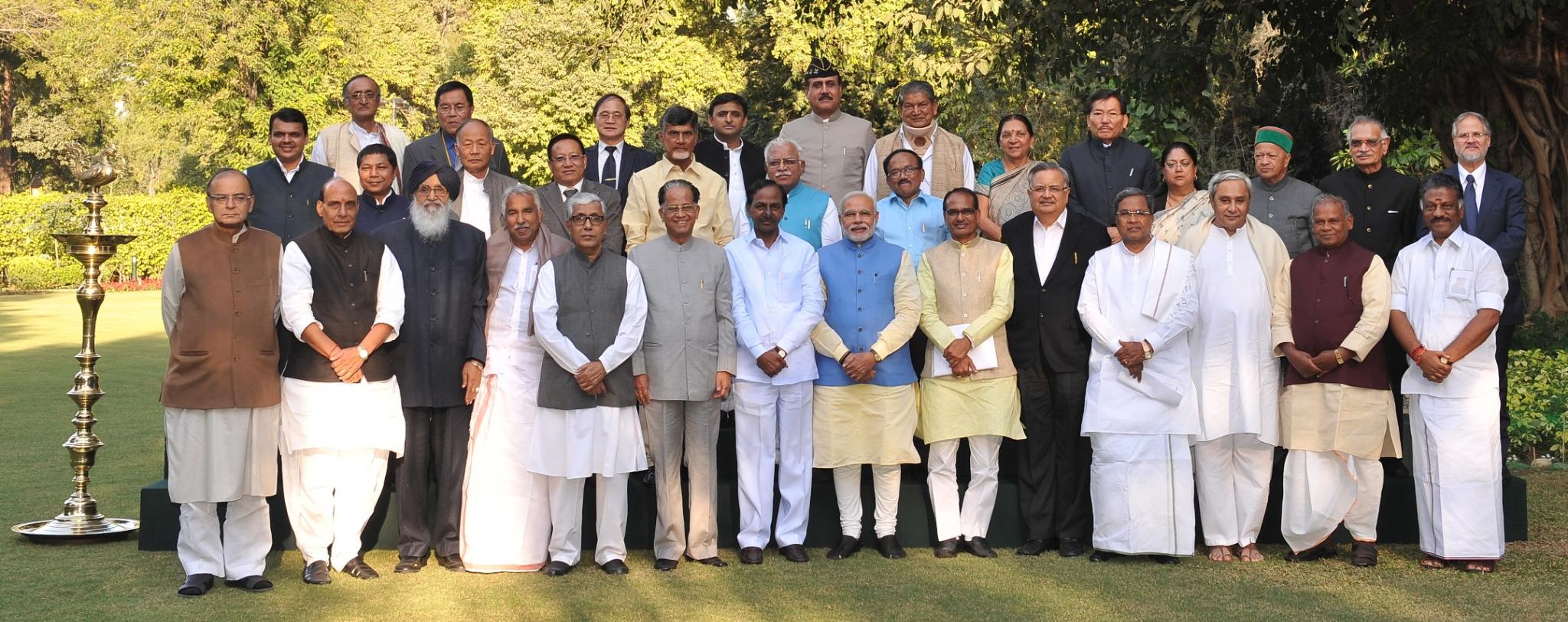
The Prime Minister, Shri Narendra Modi, after the formal Consultation Meeting with Chief Ministers on the new institution to replace the Planning Commission, held a Retreat with the Chief Ministers.
The Retreat is a first of its kind where the Prime Minister and Chief Ministers met without the support of any officials in a relaxed, private setting and discussed developmental issues and specific success stories in their states. The purpose is to learn from each others` successes so that they could be replicated in other states.
Chief Ministers highlighted one area each where they had done something innovative and which had a visible impact, either in improving governance or in improving service delivery to citizens.
All the participants felt that this was an extremely useful exercise which could be repeated in future.
Most CMs back Modi on alternative to plan panel; Congress, TNC oppose
Prime Minister Narendra Modi’s call for replacing the Planning Commission with a suitable institution found support from “most” chief ministers Sunday, but those from Congress-ruled states and West Bengal wanted any changes should be made within the existing framework.
The meeting held at the Prime Minister’s official 7, Race Course Residence, was followed by a first-of-its-kind “retreat” where the chief ministers discussed innovative practices. West Bengal Chief Minister Mamata Banerjee skipped the meeting.
In his opening remarks, Modi said states should have key role in the new body that replaces the commission and there should be an effective mechanism to address inter-state disputes.
He said relevance of the poll panel has been repeatedly questioned for more than two decades and policy planning should be “bottom to top” instead of the other way round.
“Can we develop a new mechanism, that plans according to India’s strengths, empowers states, and brings on board all economic activity, including that which happens outside the government,” he asked.
Modi said Team India comprised of three teams – the prime minister and chief ministers, union council of ministers, and the bureaucracy at the centre and states.
Referring to the role of think tanks in countries like the US, Modi said there was need to devise policies for “a great deal of economic activity” that takes place outside the government.
“Time has come to develop a new mechanism to deliver growth and development,” he said and referred to his own experience as Gujarat chief minister.
Modi said his predecessor Manmohan Singh, in his remarks at a meeting of plan panel earlier this year, had noted that the body has “no futuristic vision in post-reform period”.
Briefing reporters after the meeting, Finance Minister Arun Jaitley said that most chief ministers favoured replacing the commission with an alternative structure which has representation from the central government and the states and expert participation also.
Referring to Congress chief ministers, he said: “A few, while agreeing with the general principles of change, felt if the present Planning Commission could evolve into that structure,” he said.
On the final decision of the government, Jaitley said a considered view will be taken after consultations are over but he did not specify a time frame.
The minister said there was a large consensus at the meeting that “the context has changed and there is need to decentralise both power and planning”.
He said most chief ministers felt that there was a fallacy that “one size fits all” and the requirement of each state was different and the states know what suits them the best. The chief ministers felt that the strategy has to be to empower the states and strengthen federalism, he said.
Most states favoured a system which strengthens their ability to deliver and wanted more flexibility “rather than a controlled and command structure”, he said.
He said Banerjee sent a letter to the prime minister suggesting that the Inter-State Council (ISC) should be given a role in the planning process.
In her letter, Banerjee urged Modi not to “dilute the autonomy of the states” but to protect and strengthen the nation’s federal character, while assigning the ISC with decision making responsibilities instead of setting up a new body.
Sources said that the new body could comprise of the prime minister, some senior cabinet ministers, a few chief ministers on a rotational basis and some experts.
Congress general secretary Ajay Maken cautioned the government against diluting the plan panel’s functions, and called for opposing the “short-sighted” and “dangerous” move, “made in a devious manner characterized by typical subterfuge and doublespeak”. Party chief ministers, including Oommen Chandy and Virbhadra Singh, also opposed the move.
Some non-Congress, non-BJP chief ministers, however, left it to the government but stressed on greater role of states.
Modi, in his Independence Day address, had announced that a new institution would be set up “in a short span of time” to replace the commission.
The commission was conceived by India’s first prime minister Jawaharlal Nehru and set up March 15, 1950.
Congress condemns move to replace plan panel
The Congress Sunday condemned the move by the Narendra Modi government to replace the Planning Commission with a new body, saying that the effort was “characterised by subterfuge and doublespeak”.
Party general secretary Ajay Maken said in a statement that the government intends to distribute the functions of planning commission amongst the ministry of finance and subject matter ministries, which will result in loss of perspective and of long term view.
The party “cautioned the government against diluting the planning commission’s functions that ensure socio-economic justice and robust federalism, in the name of reforms aimed at benefitting vested interests and corrupt practices in project implementation”.
It said the move to replace Planning Commission had taken the country by surprise.
“The resulting uncertainty in the country has created an untenable situation that has raised fundamental questions on the BJP government’s intent and the future of the planned development,” the Congress said.
Referring to Sunday’s meeting of Prime Minister Narendra Modi with the chief ministers, the party said: “The aim clearly is to roughshod and hoodwink for political one-upmanship.”
The statement said the idea of economic planning for an independent India was first envisaged in Haripura session of the Congress in 1938 presided by Netaji Subhas Chandra Bose.
“He declared the first task of the government of free India as being the setting up of a National Planning Commission. The Congress set up a National Planning Committee with Jawaharlal Nehru as its chairman,” the statement said.
The statement said that though the country had embraced a market economy, the fruits of development have not reached millions of people.
“Therefore, planning is essential. India cannot let the market forces decide the destiny of marginalized people.”
Mamata opposes new body replacing Planning Commission
Opposing creation of a new body to replace the Planning Commission, West Bengal Chief Minister Mamata Banerjee has written to Prime Minister Narendra Modi urging him not to “dilute the autonomy of the states” but to protect and strengthen the nation’s federal character.
Banerjee, who skipped Modi’s Sunday meeting with chief ministers in New Delhi to discuss the structure of the new structure that would substitute the Planning Commission, in a letter called for assigning the Inter-State Council (ISC) with decision making responsibilities instead of setting up a new body.
“Any new structure that is thought of, should strengthen the role of the states and eliminate actions like discretionary fund transfers. The activities of the proposed new body should flow out of constitutional mandates and should be assigned a major role in handling issues between the centre and the states,” said Banerjee in the letter.
“Instead of setting up a new body, it may be more appropriate to assign the decision-making responsibilities of the Planning Commission to the ISC. The Council, which is a constitutional entity, has a secretariat which will require suitable strengthening.
“The existing constitutional provisions could be appropriately modified to enable the ISC to discharge its augmented range of functions. In the same vein, the National Development Council should also be subsumed with the new dispensation,” suggested Banerjee, also the Trinamool Congress chief.
She also asserted that an existing functional mechanism should not be dismantled without putting in place a “credible and capable body with a statutory mandate”.
“I may also add that the new structure should not, in any way, dilute the autonomy of the states including fiscal autonomy and, in fact, protect and strengthen the federal character of the nation as enshirined in the constitution,” she added.
Addressing the media after the first round of the meetings, Union Finance Minister Arun Jaitley claimed that most chief ministers have favoured an alternative structure that would replace the Planning Commission.
Recent Stories
- Diwali Food Safety Drive: AMC Seals Two Units, Fines Four Outlets ₹40,000
- HDFC Bank Gets Govt Nod to Offer Deposits Under Capital Gains Accounts Scheme
- GSSSB Announces Recruitment for 1,237 Class-3 Posts; Applications Open on November 5
- AMC to Hike Parking Fees; Proposed New Rates Here
- Mumbai Mayor Ritu Tawde Meets Gujarat CM Bhupendra Patel
- Holiday Inn Resort to Come Up in Sasan Gir