
India, Japan sign Nuclear deal, 10 pacts, cover areas like space, agriculture
November 11, 2016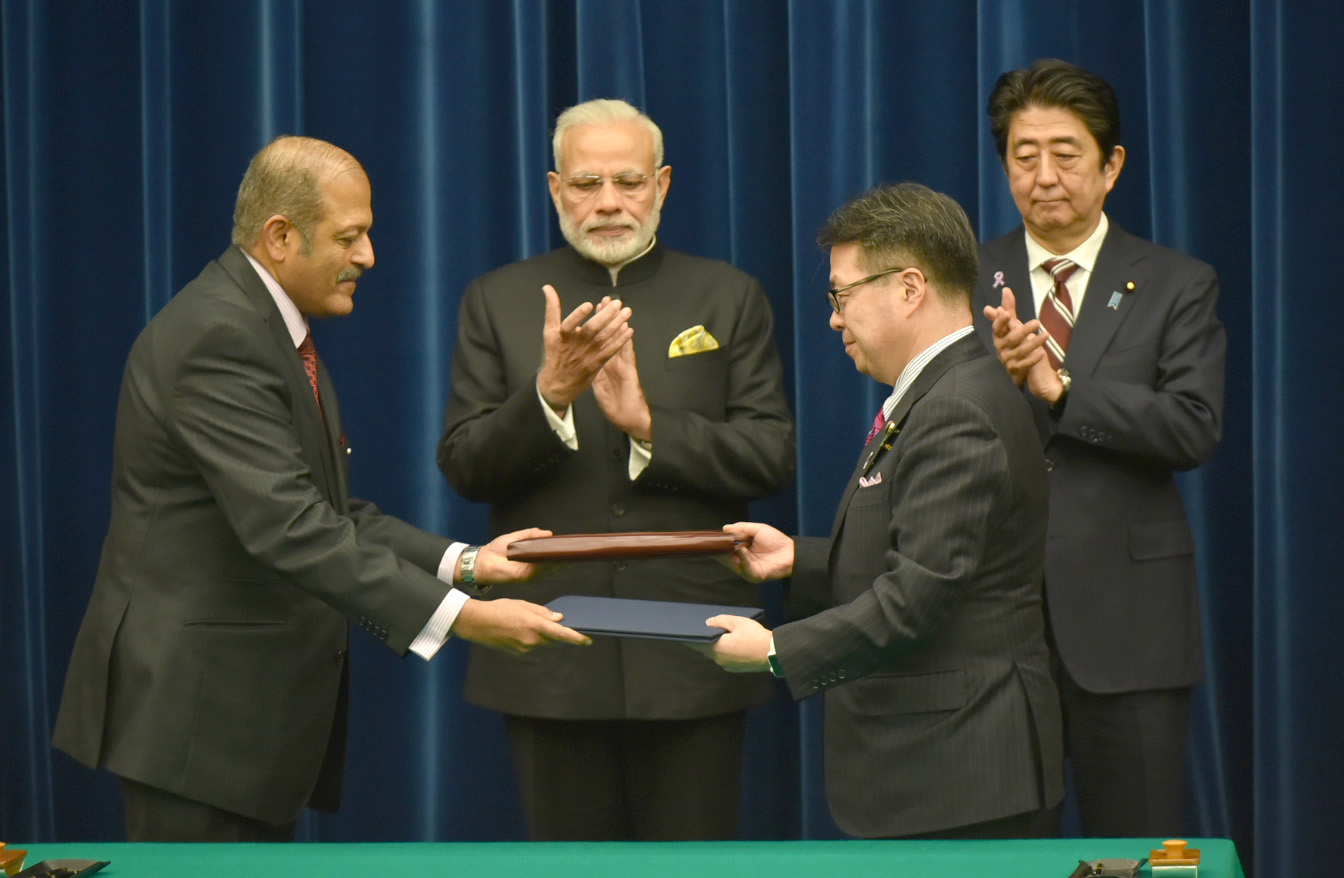
Tokyo: India and Japan today signed 10 pacts covering a range of areas such as boosting Japanese investment in infrastructure, railways, and for cooperation in space and agriculture, as part of agreements to bolster bilateral ties.
An MoU was signed between the National Investment and Infrastructure Fund Limited and Japan Overseas Infrastructure Investment Corporation for Transport and Urban Development to enable cooperation and promote investment in infrastructure projects in railways & transportation; port terminals; toll roads; airport terminals and urban development.
“This MoU would also enable the two sides to explore opportunities to set up a NIIF-JOIN joint fund,” the Ministry of External Affairs said in a statement.
Two memorandum of understandings were signed to boost cooperation in space technology. One of the MoUs between Indian Space Research Organisation (ISRO) and Japan Aerospace Exploration Agency (JAXA) concerned cooperation in outer space in satellite navigation and planetary exploration.
It also included joint missions and joint use of ground systems for mutual support.
The other MoU between India’s Ministry of Earth Sciences and the Japan Agency for Marine-Earth Science aims to promote cooperation in areas of joint survey and research, and exchange of scientific visits by researchers and experts.
India and Japan also signed a landmark deal for civil nuclear cooperation after talks between Prime Minister Narendra Modi and his counterpart Shinzo Abe. The move is likely to boost bilateral economic and security ties and facilitate US-based players to set up atomic plants in India.
The deal allows Japan to export nuclear technology to India, making it the first non-NPT signatory to have such a deal with Tokyo. It cements bilateral economic and security ties as the two nations warm up to counter an assertive China.
In past two years, India received about USD 55 billion in foreign direct investments, which, Modi has said during this visit, is “not only the highest ever FDI but also highest growth in FDI in India”.
Another fixture from the deals signed was cooperation in the agriculture sector.
The two countries signed a Memorandum of Cooperation (MoC) to deepen bilateral cooperation in agriculture and food industries – that includes food value chain networking and protecting Geographical Indication (GI) of agriculture products.
GI is a sign used on products that have a specific geographical origin and possess qualities or a reputation that are due to that origin.
The MoC, a framework document, would provide for specific agreements between concerned agencies between both sides.
The two countries will also cooperate in the area of skill development. An MoC signed in this regard “envisages training 30,000 Indian youth in the Japanese-styled manufacturing in the next 10 years,” according to the statement.
Programmes under this MoC would contribute to ‘Make in India’ and ‘Skill India’.
Another agreement was aimed at improving the quality of Indian textiles “for conformity assessment” for Japanese market, the statement said.
Two pacts were signed to promote bilateral cooperation in the field of art and culture, and in sports ahead of the 2020 Tokyo Olympics and Paralympics for training of coaches and athletes.
The 10th pact was signed between the state of Gujarat and Japan’s Hyogo Prefectural Government to promote cooperation between them in the fields of academics, business, culture, disaster management and environmental protection.
India, Japan sign landmark civil nuclear deal
Tokyo: Shedding its reservations, Japan today made an exception to sign a landmark civil nuclear deal with India, opening the door for export of its atomic technology and reactors, after adding features like safety and security keeping in mind its sensitivities on the issue.
The nuclear deal, described as historic by Prime Minister Narendra Modi, was part of the ten agreements signed between the two countries in various areas after he held talks with his Japanese counterpart Shinzo Abe on the second day of his three-day visit.
The nuclear agreement comes after tough negotiations for over six years between the two countries and Foreign Secretary S Jaishankar said the nuclear deal was similar to the agreements signed with the US and other countries with added features on safety and security in keeping with Japan’s sensitivities.
At the joint media interaction with Modi, Abe said he was delighted over the signing of the agreement on peaceful use of nuclear energy.
“This agreement is a legal framework that India will act responsibly in peaceful uses of nuclear energy and also in Non-Proliferation regime even though India is not a participant or signatory of NPT,” he said.
“It (the agreement) is in line with Japan’s ambition to create a world without nuclear weapons,” said Abe, whose country has traditionally adopted a tough stand on proliferation issues having been the only victim of atomic bombings during World War II.
He noted that India in September 2008 had made its intention of peaceful uses of nuclear energy and also announced moratorium on nuclear tests.
“Today’s signing of the Agreement for Cooperation in Peaceful Uses of Nuclear Energy marks a historic step in our engagement to build a clean energy partnership,” Modi said.
“Our cooperation in this field will help us combat the challenge of Climate Change. I also acknowledge the special significance that such an agreement has for Japan,” he said and thanked Abe, Japanese government and Parliament for their support to this agreement.
The deal would allow Japan to export nuclear technology to India, making it the first non-NPT signatory to have such a deal with Tokyo. It would also cement the bilateral economic and security ties as the two countries warm up to counter an assertive China.
There was political resistance in Japan – the only country to suffer atomic bombings during World War II – against a nuclear deal with India, particularly after the disaster at the Fukushima Nuclear Power Plant in 2011.
Abe pushed for universalisation of the NPT, entry into force of Comprehensive Nuclear-Test-Ban Treaty (CTBT) and start of negotiations at the earliest on Fissile Material Cutoff Treaty (FMCT).
Later, a joint statement said, “The two Prime Ministers welcomed the signing of the Agreement between the Government of Japan and the Government of the Republic of India for Cooperation in the Peaceful Uses of Nuclear Energy which reflects a new level of mutual confidence and strategic partnership in the cause of clean energy, economic development and a peaceful and secure world.”
In his remarks, Prime Minister Modi said as democracies, the two countries “support openness, transparency and the rule of law”.
“We are also united in our resolve to combat the menace of terrorism, especially cross-border terrorism,” he said.
The two sides also called upon all countries to work towards eliminating terror safe havens, disrupting their networks and stopping cross-border movement of terrorists, in an apparent reference to Pakistan.
“The two Prime Ministers condemned terrorism in strongest terms in all its forms and manifestations in the spirit of ‘zero tolerance’,” the joint statement said.
The two leaders noted with great concern the growing menace of terrorism and violent extremism and its universal reach.
“They called upon all countries to implement the UNSC Resolution 1267 and other relevant resolutions designating terrorist entities,” it said, referring to India’s bid to get Jaish-e-Mohammed chief Masood Azhar designated as global a terrorist under this resolution.
China – a veto-wielding permanent member of the Security Council – had blocked India’s move to put a ban on Azhar under the Al-Qaeda Sanctions Committee of the Council.
Regarding bilateral economic and trade ties, Modi said deeper economic engagement, growth of trade, manufacturing and investment ties, focus on clean energy, partnership to secure the citizens, and cooperation on infrastructure and skill development are among key priorities in the Indo-Japan relationship.
“India and its economy are pursuing many transformations.
Our aim is to become a major centre for manufacturing, investments and for the 21st century knowledge industries.
“And, in this journey, we see Japan as a natural partner.
We believe there is vast scope to combine our relative advantages, whether of capital, technology or human resources, to work for mutual benefit,” he said in his joint interaction.
The Prime Minister said that the strategic partnership between the two countries also brings peace, stability and balance to the region. It is alive and responsive to emerging opportunities and challenges in Asia-Pacific, he said.
The successful Malabar naval exercise has underscored the convergence in the two sides’ strategic interests in the broad expanse of the waters of the Indo-Pacific, Modi said.
On his part, Abe mentioned the high speed train corridor between Mumbai and Ahmedabad that is being built with the help of Japan, saying the project symbolizes a new dimension in the special relations.
Prime Minister Abe said the designing of the project will begin by the end of this year, construction will begin in 2018 and the high speed train will be in service from 2023.
He said Modi, who will travel by one such train to Kobe city tomorrow from here, will see for himself that it is the safest technology in the world.
The Japanese private sector also would be setting up an institute of manufacturing in India to train about 30,000 people in 10 years, particularly in rural areas, Abe said.
Abe said Japan will set up a tourism bureau in New Delhi to encourage people-to-people contacts. He said he wants to work with Modi in liberalizing the visa rules.
“India-Japan relations have the greatest potential in the world. Strong India is in the best interest of Japan and strong Japan is in the best interest of India,” Abe said.
Noting that he had met Modi for the third time in one year, Abe praised him, saying he had a “global vision” and was a “decisive leader”.
Later briefing reporters, Jaishankar said there was “meeting of minds” between the two sides on a large number of issues and a major focus area was to further ramp up economic cooperation.
He said Japanese investment in India has gone up and priority would be given to infrastructure projects including the dedicated freight corridor and Delhi-Mumbai Industrial Corridor.
Jaishankar said the “full architecture” to take forward the eco cooperation was one of the major highlight of the talks.
Asked about the proposed purchase of 12 US-2 aircraft from Japan, the Foreign Secretary said the issue came up for some discussion and that India was still evaluating the requirement of the aircraft.
On flagship high speed rail project, he said some important decisions were taken about it, adding it was agreed that the general consultant will start work in December while construction work will start by end of 2018 and the network will be made operational by 2023.
PTI
Recent Stories
- Diwali Food Safety Drive: AMC Seals Two Units, Fines Four Outlets ₹40,000
- HDFC Bank Gets Govt Nod to Offer Deposits Under Capital Gains Accounts Scheme
- GSSSB Announces Recruitment for 1,237 Class-3 Posts; Applications Open on November 5
- AMC to Hike Parking Fees; Proposed New Rates Here
- Mumbai Mayor Ritu Tawde Meets Gujarat CM Bhupendra Patel
- Holiday Inn Resort to Come Up in Sasan Gir