
Science City organizes outreach programme to mark Summer Solstice on 21st June, the longest day of year
June 20, 2012
Ahmedabad, 20 June, 2012
 Ahmedabad based Gujarat Science City will organize student and public outreach programme to explain the science of solar solstice at Science city campus and all community science centres in all districts of Gujarat on 21 June, said senior scientist Shri Narottam Sahu.
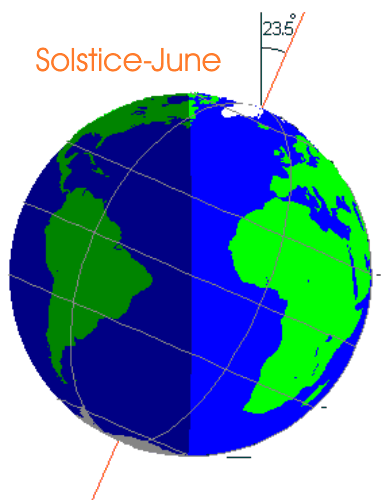
On or around June 21 each year, the rays of the sun will be perpendicular to the Tropic of Cancer at 23°30′ North latitude. This day is the summer solstice in the Northern Hemisphere.
Countries lying to the north of the equator, including India, will witness ‘Summer Solstice,’ a phenomenon that occurs when the earth’s axial tilt is most inclined towards the sun on 21st June.
A solstice is an astronomical phenomenon, which happens twice a year, when the tilt of the earth’s axis is most inclined towards or away from the sun, causing the sun’s apparent position in the sky to reach its northernmost or southernmost extreme. The term is derived from the Latin words ‘sol’ (sun) and ‘sistere’ (to stand still).
On this day, the earth’s “circle of illumination” will be from the Arctic Circle on the far side of the earth (in relation to the sun) to the Antarctic Circle on the near side of the earth. The equator receives twelve hours of daylight, there’s 24 hours of daylight at the North Pole and areas north of 66°30′ N, and there’s 24 hours of darkness at the South Pole and areas south of 66°30′ S.
June 21 is start of summer in the Northern Hemisphere but simultaneously the start of winter in the Southern Hemisphere. It’s also the longest day of sunlight for places in the Northern Hemisphere and the shortest day for cities south of the equator.
However, June 21 is not the day when the sun does not rise earliest in the morning nor when it sets latest at night. As we’ll see – the date of earliest sunrise or sunset varies from location to location.
During ‘summer solstice’, the Northern Hemisphere witnesses its longest day of the year while the Southern Hemisphere sees its shortest day.
After this, the length of the day starts decreasing and it reaches a point when day and night become equal in length.
The day continues to grow shorter till ‘winter solstice’, when the shortest day of the year will be witnessed on 21st December.
Recent Stories
- Diwali Food Safety Drive: AMC Seals Two Units, Fines Four Outlets ₹40,000
- HDFC Bank Gets Govt Nod to Offer Deposits Under Capital Gains Accounts Scheme
- GSSSB Announces Recruitment for 1,237 Class-3 Posts; Applications Open on November 5
- AMC to Hike Parking Fees; Proposed New Rates Here
- Mumbai Mayor Ritu Tawde Meets Gujarat CM Bhupendra Patel
- Holiday Inn Resort to Come Up in Sasan Gir