
How ₹367-crore Museum of Royal Kingdoms at Statue of Unity will bring history alive?
October 31, 2025
Ekta Nagar: On the eve of Rashtriya Ekta Diwas, with reverence to our shared heritage and promise of unity, Prime Minister Narendra Modi laid the foundation stone of the Museum of Royal Kingdoms of India — an endeavour of honour and legacy, to be built at an estimated cost of ₹367 crore.
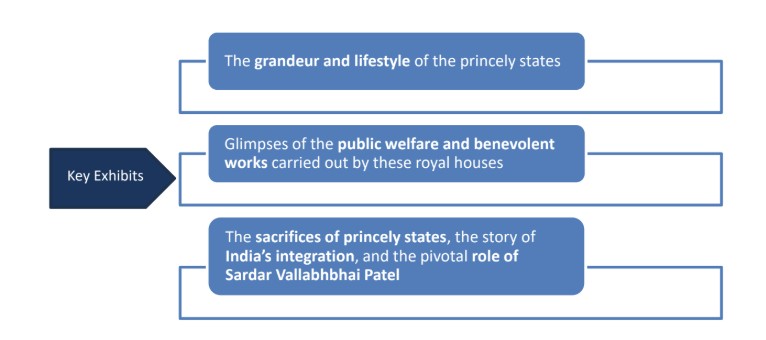
The Museum of the Royal Kingdom of India, will serve as a national repository celebrating India’s royal heritage with galleries of regalia, artefacts, textiles, manuscripts, paintings, and archival materials from various dynasties and princely states.
To be developed on five acres of land near the Statue of Unity in Ekta Nagar, the museum will feature four thematic galleries, offering visitors an interactive experience through historical artefacts, documents, and digital installations. It aims to preserve the memory of the past while inspiring future generations with the enduring spirit of unity and sacrifice.
Historical Background
At the time of India’s Independence on 15 August 1947, the subcontinent comprised British-administered territories and over 550 princely states and kingdoms. The political integration of these states into the Indian Union represents one of the most defining achievements of our nation post-Independence.
Under the leadership of Sardar Vallabhbhai Patel, then Deputy Prime Minister and Home Minister, the rulers of the princely states were persuaded to accede to India through the Instrument of Accession.
By 1949, nearly all princely states had joined the Indian Union, laying the foundation for a unified and sovereign Republic.
This peaceful unification stands as a testament to India’s spirit of diplomacy, inclusivity, and nation-building.
Objectives
The museum initiative has been envisioned with the following key objectives:
- To document and display the rich legacy of India’s royal and princely states.
- To preserve artefacts and archival materials that reflect India’s royal traditions and their contribution to the nation’s unity and cultural identity.
- To educate and engage the public on the historical process of integration, the contribution of the princely states and the evolution of India’s governance and cultural unity.
- To serve as a centre for research, preservation, and public learning on India’s regal and democratic heritage.
Key Design Features
The museum will offer a variety of engaging and educational features for visitors.
-
Inspired by the National Education Policy (NEP) 2020, the museum will feature a dedicated gallery for interactive and experiential learning, allowing visitors to explore history in an engaging and participatory manner.
-
The architecture is designed to harmonise with the natural landscape, incorporating water bodies, fountains, courtyards, and gardens as its core structural elements.
-
Visitors will enter through a landscape inspired by royal gardens, setting the tone for the grandeur within.
-
The visit will conclude at the Museum Café, where tourists can savour royal cuisine while reflecting on their experience.
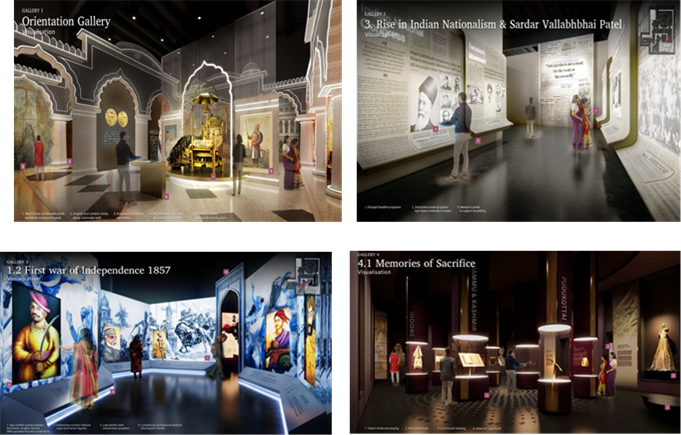
Spread across four thematic galleries, the museum will provide visitors with a rich, immersive, and interactive experience through historical artefacts, documents, and digital installations.
Gallery Overview
-
Gallery 1: Orientation Gallery – An introduction to royalty and the museum’s story through films and audio-visual narratives.
-
Gallery 2: “The Throne and the State” – Will showcase royal families, their systems of governance, traditions, welfare policies, and their relationship with their people.
-
Viewing Lounge and Deck – A rest and viewing area offering panoramic views of the Statue of Unity and the Narmada River.
-
Gallery 3: “The Story of India’s Integration” – Will depict the events and documents associated with the political integration of India.
-
Gallery 4: “Hall of Unity” – Will display the symbols and insignias of all princely states, honouring their sacrifices for India’s unity.
Conclusion
The integration of princely states is a remarkable achievement of independent India, symbolising unity in diversity and national triumph. The proposed Museum of the Royal Kingdom of India will celebrate this historic process, preserve India’s royal legacies, and highlight their role in shaping cultural and political identity. Combining heritage with modern interpretation, the museum will act as a living repository of India’s royal past, enhancing a vision of a united, inclusive, and culturally vibrant nation.
Recent Stories
- Hindu Minor Lured Into Love Trap, Fake Aadhaar Used to Book Hotel Room; Three Held in Ahmedabad
- Delivery of 10 New Trainsets for Ahmedabad Metro to Commence from June 2026
- AMC Announces Ahmedabad Innovation and Startup Policy 2026, ₹250 Crore Fund Planned
- Domestic LPG Supply in Gujarat: Govt Says Stock Sufficient, Booking Available via WhatsApp, App, IVRS
- ACB Gujarat Nabs In-charge Assistant Municipal Commissioner in ₹1 Lakh Bribe Case