
Gujarat’s Share in National GDP Climbs from 5.1% to 8.3% in Two Decades: Finance Minister
February 28, 2026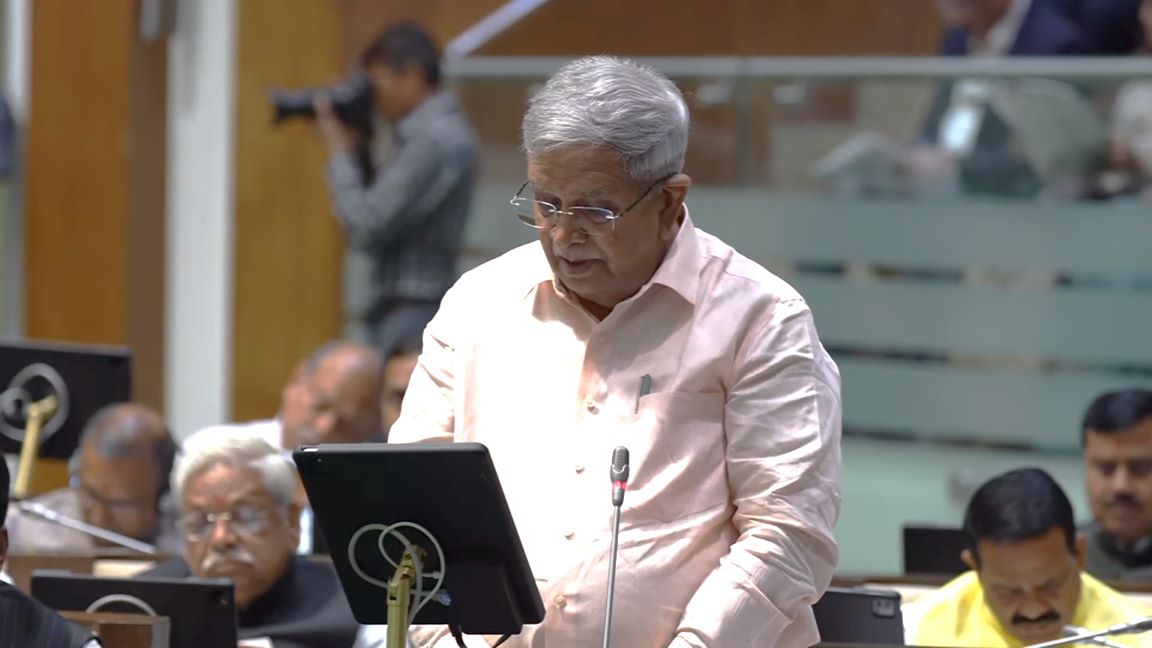
Gandhinagar: On the concluding day of the general debate on the Budget in the Gujarat Legislative Assembly, Finance Minister Kanubhai Desai presented a comprehensive picture of the state’s economic position and fiscal discipline, a press release stated.
The Finance Minister emphasized that the Budget for 2026–27 is not merely a statistical document but a comprehensive roadmap aimed at the holistic development of four key pillars the poor, youth, farmers, and women.
Referring to the Sustainable Development Goals (SDGs) India Index, he said Gujarat ranks first in the country in “Good Health and Well-being.” The state’s score has improved significantly from 52 in 2018 to 90 at present.
On the occasion of the 150th birth anniversary of Bhagwan Birsa Munda, the government has placed special focus on tribal welfare and has set a target of undertaking development works worth Rs. 2 lakh crore over the next five years under the Tribal Welfare Scheme. In the current Budget, a provision of Rs. 35,780 crore has been allocated for tribal development, aimed at accelerating socio-economic progress in tribal communities, the FM said.
Highlighting Gujarat’s economic strength, Desai said the state is among the fastest-growing economies in India. Over the past two decades, Gujarat’s contribution to the national GDP has increased from 5.1 percent to 8.3 percent. The state has recorded an average growth rate of 11.4 percent over the last 10 years, compared to the national average of 10.2 percent. Gujarat’s per capita income now stands at over 60 percent above the national average.
Gujarat ranks first in the country in total industrial production with a 19 percent share and in exports with a 26 percent share. To further boost exports, the Budget has announced the establishment of the Gujarat State Export Promotion Council (GEPC), which will provide a global platform for the state’s traders.
The Minister said the 16th Finance Commission has described Gujarat’s power system as the best in the country. All four DISCOMs have consistently maintained top performance. Power purchase costs have been reduced through technological innovation and GUVNL’s Single Buyer Model. Distribution efficiency has improved through the HVDS system and GPRS metering, significantly reducing losses.
He added that DISCOMs, benefiting from timely government subsidies, are paying an interest cost of only 0.97 percent, compared to the national average of 7.44 percent.
Desai further stated that Gujarat has successfully achieved all fiscal targets under the Fiscal Responsibility and Budget Management (FRBM) Act, 2003. For the past 22 years, from 2004–05 to 2025–26, the state has not resorted to an overdraft even once.
The state has maintained a revenue surplus for the last 10 years, except during the COVID year. For 2025–26, a revenue surplus of Rs. 23,725 crore has been estimated.
Regarding public debt, he said the permissible limit is 27.10 percent of the state’s GSDP. Despite a 10.21 percent increase in the Budget size, the state’s debt is projected to remain at 14.65 percent in 2026–27. The fiscal deficit will also be kept below 2 percent against the permissible limit of 3 percent.
Due to efficient financial management, interest expenditure as a percentage of revenue receipts has been reduced to 20 percent, and the government aims to bring it down further to 10.86 percent in 2026–27.
Addressing traders and taxpayers, the Minister said revisions in GST rates by the Government of India are expected to result in savings of approximately Rs. 11,000 crore for people in Gujarat.
Additionally, 90 percent of refund claims based on risk assessment will now be issued as provisional refunds within seven days. Over the last three months, 52,000 new traders have registered under GST, taking the total number of registered taxpayers to 13.69 lakh. Consequently, GST revenue has increased by 12 percent.
Earlier, traders from Jamnagar had to travel to Junagadh for GST registration. The government has now started GST registration services in Jamnagar for two days a week. Similar facilities will soon be introduced in Anand, Bharuch, Morbi, Surendranagar, Bhuj, and Patan.
The Budget has also extended the 1 percent tax on electric vehicles for another year, providing relief of Rs. 210 crore to citizens.
Concluding his address, the Minister said that over 1,100 entities have been registered by IFSCA at GIFT City. With 38 national and international banks, 67 insurance companies, 60 fintech firms, and several other financial institutions operating there, GIFT City has emerged as a major global hub for offshore financial services.
The total size of banking assets at GIFT City has increased sevenfold over the past seven years, while monthly exchange turnover has crossed US$100 billion, reflecting its growing global stature. DeshGujarat
Recent Stories
- Gujarat HC Seeks NHAI Affidavit on NH-8 Repairs, Toll Collection and Maintenance Spending
- Surat - Mangaluru Express Regularised; Direct Link to Goa and Karnataka
- Gujarat Likely to Get 11 Greenfield Airports as Centre Approves UDAN 2.0
- Petrol Pump Licence Suspended, Case Filed Against Rajkot Dealers Association Chief
- GIFT City to Get New International School; Priority Admission for Employees’ Children