
Lost decade under UPA and risk of Demographic Curse
June 27, 2013
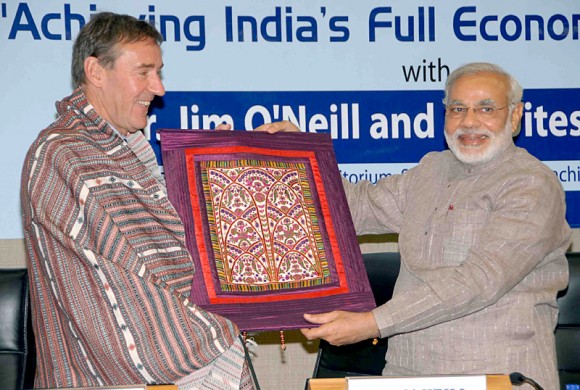
Ahmedabad, 27 June 2013
While everyday there is a statement on Narendra Modi by all and sundry. To add to stupidity all kind of inane comments on why as a CM he tried to help his state people from calamity is being played non-stop. On the otherhand, the social media is all abuzz with Missing Rahul Gandhi where a Twitter hashtag #WhereIsPappu was trending. In all these chaos, the biggest news is, Rupee has tanked to the lowest ever. The situation is worse than 1991 according to some.
For the starters who don’t know Jim O’Neill, he is the father of term BRICs. In 2003, this report from Goldman Sachs changed the flow of global money. He and his team bet much higher on India out of 4 countries, he was the most upset in 2011 blaming Indian central leadership for failing. http://articles.economictimes.indiatimes.com/2011-12-01/news/30463190_1_external-shocks-growth-environment-scores-fdi Two years later, he realized there is some hope for India and he gave insights on way out for India in the company of Narendra Modi.
In this article I would like to stick to my own assessment on what ails India and then move to grand plan of SIR in the next article.
All the hype around India’s great future rests on one unmovable presumption and that is “Demographic Bonus”. Every country has ridden the development wave when they were in the midst of demographic Bonus age. Today demography is in India’s favor. More than 50% of India’s population is below 25 years. It is argued that these sheer numbers of young people will propel India to next growth orbit by being both powerful producers and great spenders. Even the BRICs or McKinsey report rests their conclusion based on these assumptions. While BRICs report is more than a decade old, India in last “lost decade” has completely disappointed all stakeholders within and outside.
In order to get Demographic Bonus, three things are immensely important. (1) To Increase Industrial growth to offset fiscal deficit. (2) Employment Generation in manufacturing. (3) Creating sustainable cities for aspiring population to live healthy life.
In absence of all, the much hyped Demographic “Bonus” will as well be “Onus”
Let us look each of these points in detail to drive my point before I go in explanation of why Special Investment Region could be the answer to these chronic problems plaguing India.
In 2011, Sam Pitroda shared a very alarming picture. In his own words, “Electronic hardware (imports) could be $400 billion if we’re not careful, in the next 10-15 years. “It could be more than oil.” India he said wants to upgrade its industrial base to diversify from service sector-led growth, create more jobs, and curb a swollen trade deficit that could more than double in three years, due in part to billions of dollars worth of Chinese imports. (read more )

Today as I write, rupee is approaching 60 and India’s fiscal deficit is at alarming stage. Not to mention policy paralysis and love for inane freebies scheme, the biggest reason for current situation is slump in industrial sector. For last decade, license Raj has returned and policy paralysis coupled with more controls have only choked manufacturing. So much so that contribution of manufacturing sector in GDP has slumped to 15.4%. Considering by 2020 even China will have negative growth in productive population, it is indeed a surprise we don’t see the writing on the wall. While even planning commission also understands this and comes out with brilliant paper (http://planningcommission.nic.in/aboutus/committee/wrkgrp12/wg_mfg.pdf ) unfortunately the Nehruvian straight jacket policy maker from Delhi do not have any clue how to implement this at ground level. While Gujarat shows the way and gets huge pat on the back in closed door, the endorsement and encouragement of adapting the same for other states never come easy.
Globally when India is compared to China one thing that strikes every economic student is India’s skewed GDP structure for a developing nation. For any nation on the path of growth should have bulk of economy supported by manufacturing sector. For this sector has maximum potential for value addition and besides helping import substitution it immensely helps in international trade with economies of scale.
As depicted in graph below you can check the contribution to GDP v/s people employed in Agriculture and Services sector, you know the importance of Manufacturing.

Every year India produces more than 1.5 million engineering graduates. We are proud in saying that is more than USA and China combined. But the slowdown in economy has alarming situation for jobs. The number of unemployed rose to 10.8 million in January 2012, from 9.8 million in January 2010. Official data released in 2011 had showed that just 2.7 million new jobs were created in the five years between 2004-05 and 2009-10 — sharply lower than the 60 million jobs created in the previous five years. Many economists who were suspecting a strange situation of “Jobless Growth syndrome” are proven right. Coupled with poor rains last year, the biggest problem is woes of manufacturing sector in India and its ability to provide jobs. For any developing country to grow productive labor’s gradual move from Agriculture to Industry and to service is imperative. The revival of Industry is a must. There is a clear danger that Demographic “Bonus” would else be turned into “Onus” if productive opportunities are not created for youth.
The attached article gives a scary scenario where few engineering graduates were found as criminal. ( http://timesofindia.indiatimes.com/tech/careers/job-trends/What-is-keeping-Indias-engineers-unemployed/articleshow/20643448.cms). The message is loud and clear generate enough jobs else.
For country like India, it is not just enough to create job, but we also need to create sustainable cities, where this human capital can live peacefully and contribute more productively. As I mentioned in my last article India does not have luxury of affordable oil and free water. The new cities have to be environmentally friendly and extremely well-planned. Let’s see example of one city that is hallmark of changing India and everything wrong about it. I am taking liberty to go more elaborate as going forward more and more states of India will urbanize.
Traditionally Gurgaon is mentioned in the Mahabharata as a city gifted to Guru Dronacharya by Kuru dynasty. Far cry from history, today’s Gurgaon impresses you with swanskins. Daily 175,000 vehicles pass by 32 Toll lanes. Stylish glass buildings, swanky malls and expensive residential condominiums, Gurgaon is known as millennium city of India.

In picture:Chaos at Gurgaon toll-gate and perennial monsoon flooding at busy Hero-Honda Chowk
However the fast paced growth without any consideration for planning has authorities gasping to catch-up with civic amenities. The picture of water logging below notwithstanding, city is very dry for water needs. The gap in demand and supply for water is staggering the 50 Million Gallon per Day. According to Authorities, ground water will be completely exhausted in Gurgaon by 2017 if the extraction continues at the same pace. All those swanky buildings virtually run on generators guzzling diesel, polluting air; making citizens literally breathless. Till now there is no public transport for city. Even Delhi metro is not provided with last mile solution. Some even jokingly say that Indus-Saraswati Valley civilization of Harappa and Dholaveera had better drainage system than Gurgaon. The roads cannot withstand ever increasing traffic. Quite often residents are on road blocking traffic or protesting against authority as their patience is running out over crumbling civic facilities. To make things worse and very ironically; in this city if you have power, then you can buy your WAY on tax-payer’s money literally.
The most prominent road in Gurgaon is Golf Course road. it is also “famous” for the alleged investment favors by DLF to Mr. Robert Vadra on this very road properties. Not sure if that is the trigger but out of blue, authorities decide to build 16 lanes expressway in the middle of city connecting Tollgate to Golf-course Road (GCR).
On face of it, idea sounds wonderful, something futuristic apt for the millennium city. But then questions started to puzzle Citizens. There are more people living on the other side is one point. But why 16 lanes is another mind boggling question. I suggest you spend some time and go to through this link below to play prezi slides to know how it could be devastating for a fragile city like Gurgaon to have an expressway running in the middle of the city.
http://iamgurgaon.org/testsite/hudas-sector-road-to-dlf-city/
It’s a wonderful summary of probable problems for city put together by concerned citizens. The message as evident in this link is for sustainable cities we need to move and connect people.
 Somewhere between history and current madness, around 30 years back, Maruti’s first factory was literally in the middle of weeds in Gurgaon. It remained so for quite a many years, until millennium wave of development took over Gurgaon. What should have been harnessed as industrial area or given it a chance to move out in phase, the unplanned town-(Un)planning has swapped that area. In less than 30 years, the area is full of concrete jungle with no sense of town planning. Today housing and commercial properties are choking Maruti’s Gurgaon factory to death. The newly developed Industrial Model Town (IMT) Manesar was created for Industry alone without having any consideration to what may happen to people who will live there.
The roads are choked, and living conditions are worsening. The last August outrage and labor unrest has more to do with pathetic living conditions for laborers as many sociologist point out. The city’s crumbling civic amenities, poor power and water infra coupled with extremely poor yet expensive housing, they all add to stress of workers.
As a result, today companies think twice before expanding in northern belt including Gurgaon- Manesar. While the exodus is not yet visible, expansion is on absolute halt. Slowdown has its first causality and that’s Gurgaon. The biggest testimony is ever increasing unsold condominiums and un-rented apartments in Gurgaon.
To be fair to Gurgaon, one must sadly admit that this is the case with whole of India. Any major metro cities are victim of this same vicious cycle. From Bangalore to Mumbai and from Chennai to NCR, there is hardly any exception. And that’s why concepts like DMIC which we discussed in previous article bring in some hope.
It is interesting to learn in this backdrop, how Gujarat is attempting to take this menace by horn. Govt is in the midst of meticulously planning new city that will spur India’s exports, grow GDP and yet will not have choking feeling for life, like we have in other metro cities.

Since getting independent 53 years back, state’s industrial policy has evolved. From simple product clusters to industrial estates to SEZs, state has embarked upon Integrated large area development in most sustainable way. And in this regard, the idea of Special Investment Region (SIR) is very important. In next article I will touch upon this unique project Gujarat is trying to embark at Mandal Becharaji Special Investment region (MBSIR) and how it has potential to answer all three questions we raised in the beginning.
Watch out for this space.
🗃️ This story is from our archives and may contain outdated information.
Recent Stories
- GMRC Extends Ahmedabad – Gandhinagar Metro Rail Timings for IPL Match Days
- Residents Allege Disturbed Areas Act Violation in Tandalja in Vadodara; Seek Cancellation of Housing Scheme
- 40-Day Traffic Restrictions, Diversions Announced in Parts of Surat for Infrastructure Work
- SMC Introduces Grease Chamber Cleaning Service for Restaurants and Cafés; Rates Announced
- ACB Gujarat Traps CPWD Engineer in ₹4.5 Lakh Bribery Case