
A mere 31% people are aware of the fact that the golden window for acute stroke is 4hrs 30mins
March 13, 2019
Ahmedabad: Blood pressure increases risk of stroke by 4 times, diabetes by 3 times and cholesterol by 2 times. But combination of all three would increase the risk by many fold. This information was shared by Dr. Vijay Kumar Sharma and Dr. Arvind Sharma while announcing the annual Indian National Stroke Conference (INSC 2019) here.
To deliberate upon the recent developments and studies related to “Stroke” (also known as Brain Attack), the best minds in the field of medical neuro science and practitioners from across South East Asia and faculties from abroad will be assembling in the city at the annual Indian National Stroke Conference (INSC 2019). Organized by The Indian Stroke Association, this 13th edition of national conference will be held from March 15-17 at Grand 07 (Forum), Ahmedabad.
Happening for the first time in Ahmedabad, the 3 day-long INSC 2019 will see over 450 delegates from across the country attending and making the most of this ideal opportunity to meet National and International Faculty in the field of Neurology and exchange knowledge & recent developments along with case studies.
“It is matter of pride to be hosting the INSC 2019 which is a National conference under the aegis of Indian Stroke Association, in the Heritage city of Ahmedabad. The key attractions at this year’s conference include Pre-conference Workshop on Neurosonology, Neurointervention and Post Stroke Rehabilitation. Besides technical sessions, a Nursing symposium, a 6-km run on the theme “Up Again after Stroke” to create awareness on how to reverse stroke, a ‘Stroke Quiz’ and an ‘ASN Exam’ which is an online exam for prestigious certification from the prestigious American Society of Neuroimaging” informed Dr Arvind Sharma, Conference Organizing Secretary and Executive member of Indian Stroke Association.
Speaking about a stroke awareness programme conducted at Ahmedabad from 29-Oct-18 to 13-Dec-18, Dr Arvind Sharma added, “While maximum people were aware that stroke can affect anyone, regardless of age and gender and that stroke is reversible and treatable, just 31% people surveyed had an idea about the golden window for acute stroke, which is 4hrs 30mins. Also, 25% did not have an idea about the symptoms of stroke.”
“Stroke is the third leading cause of death in India. Moreover, about 20% of heart patients are susceptible to stroke. While technology and medicine have evolved over time, what lacks is awareness about the symptoms of stroke and the golden period in which treatment has to be made available to the patient. During the 3 day conference, we will be discussing the advances in the field of neuro sciences and stroke. It is a platform that will be stressing on the importance of awareness about stroke. Modalities pertinent to patients in India will also be discussed,” stated Dr. Simerpreet Bal, University of Calgary, Canada.
Dr Vijay Kumar Sharma, Senior Consultant, Neurology Division-National University Hospital, Singapore said, “Ageing is the biggest risk factor for stroke. With life expectancy increasing in India, the occurrences of stroke are also on a rise. While there is awareness in the urban population regarding stroke, it lacks greatly in rural India. While we have copied the western culture and changed our lifestyle accordingly, we have not been able to match is the medical treatment. High blood pressure is one of the causes of stroke and increases risk of stroke 4 times. A Carotid Doppler test is advisable for people who are at risk of stroke- which includes those suffering from high blood pressure, diabetes, heart diseases and are heavy smokers”, Dr Vijay Sharma added.
“The conference aims at providing the recent developments and research in the field of Stroke. It will also provide impetus to the process of reversing a stroke attack and how a patient can be Up again after Stroke. This comprehensive scientific and academic conference will be attended by Neurologists, Neurosurgeons, Neuroradiologists and Stroke specialists from not only across India but from around the world along with dignitaries related to other aspects of stroke like Neurosonology and neuro rehabilitation” added Dr. Vijay Kumar Sharma.
Doctors brief:
-If you have diabetes, blood pressure, heart issue, smoking habit and family history of stroke then you must go for screening as preventive measure,” the doctors said adding that one person suffers from stroke in ever 45 second. 20% of those having heart problem suffer from stroke. Stroke is third major reason of death.
-Blood pressure is biggest factor contributing to possibility of stroke. It is so linked that BP down by 9 points can reduce the risk of stroke by 44%.
-Heart attack generally happens when you are in productive age while stroke happens when you are above 60. Heart attack would often prove fatal while only 30% of those who suffer stroke die. 2/3rd would live. Of them 30% will live disabled life. While in heart attack you would suffer from pain, stroke takes away your awareness. Stroke is treatable but time is very important. Time loss is brain loss. One should rush to nearest stroke-ready hospital that has CT scan facility. Start of treatment in 4 hours and 30 minutes post stroke is must. Moment you suffer stroke, you should rush to nearest if not the biggest stroke ready hospital.
A Primer on STROKE
Knowing the signs of a stroke is the first step in stroke prevention. A stroke, sometimes called a “brain attack,” occurs when blood flow to an area in the brain is cut off. The brain cells, deprived of the oxygen and glucose needed to survive, die. If a stroke is not caught early, permanent brain damage or death can result.
How Does a Stroke Occur?
There are two types of stroke.
Ischemic stroke is similar to a heart attack, except it occurs in the blood vessels of the brain. Clots can form in the brain’s blood vessels, in blood vessels leading to the brain, or even in blood vessels elsewhere in the body and then travel to the brain. These clots block blood flow to the brain’s cells. Ischemic stroke can also occur when too much plaque (fatty deposits and cholesterol) clogs the brain’s blood vessels. About 85% of all strokes are ischemic.
Hemorrhagic (heh-more-raj-ik) strokes occur when a blood vessel in the brain breaks or ruptures. The result is blood seeping into the brain tissue, causing damage to brain cells. The most common causes of hemorrhagic stroke are high blood pressure and brain aneurysms. An aneurysm is a weakness or thinness in the blood vessel wall.
What Are the Symptoms of Stroke?
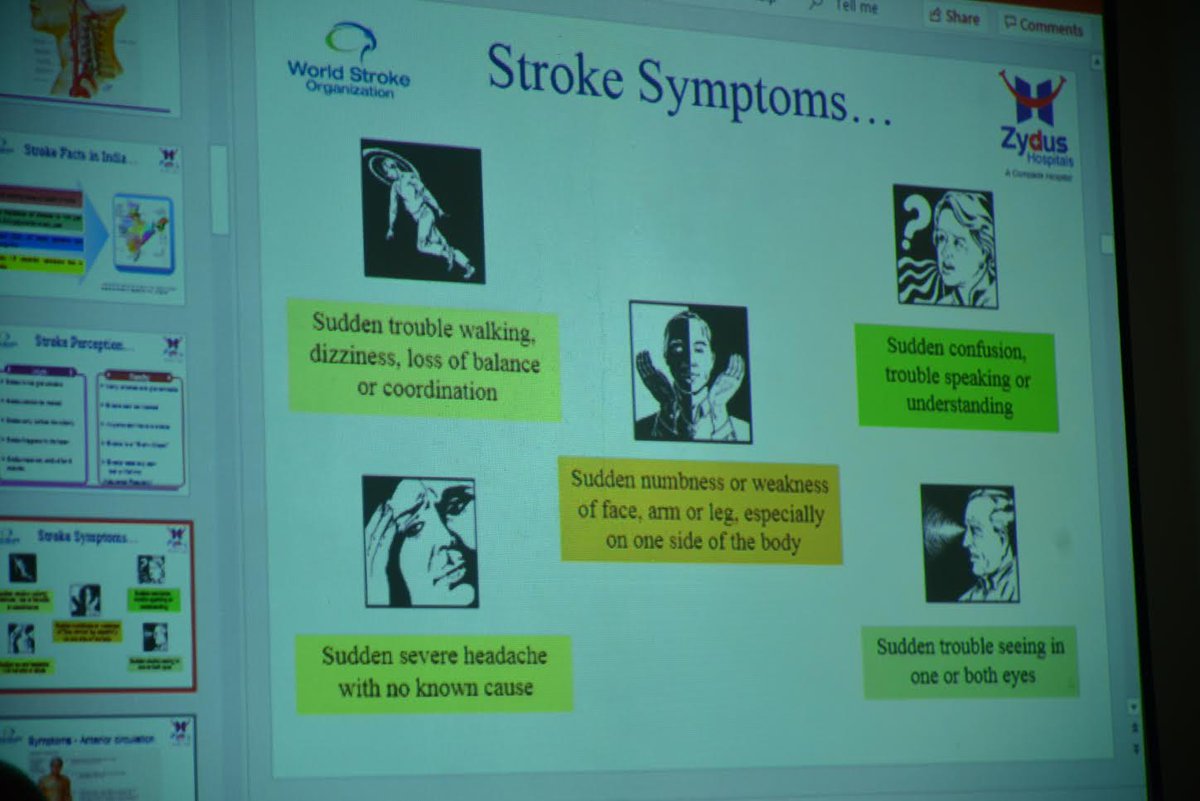
The most common symptoms of a stroke are:
Weakness or numbness of the face, arm, or leg on one side of the body
Loss of vision or dimming (like a curtain falling) in one or both eyes
Loss of speech, difficulty talking, or understanding what others are saying
Sudden, severe headache with no known cause
Loss of balance or unstable walking, usually combined with another symptom
What Should I Do If I Experience Stroke Symptoms?
Immediately call 108 if you or someone you know has symptoms of a stroke. Stroke is a medical emergency. Immediate treatment can save your life or increase your chances of a full recovery.
Is it Possible to Prevent a Stroke?
Up to 80% of all strokes are preventable. Many risk factors can be controlled before they cause problems.
(Source WebMD)
DeshGujarat
🗃️ This story is from our archives and may contain outdated information.
Recent Stories
- Centre Approves ₹451 Cr for Four-Laning of Thawar – Jherda Section of NH-168A in Banaskantha
- 78 Traffic Signals in Ahmedabad to Remain on Blinker Mode in Afternoon on Heatwave Days; Full List Here
- 33 Flats Found Illegally Rented in Koteshwar Housing Scheme; AUDA Issues Eviction Notices
- Gujarat Govt to Fill 3,100 New Posts in Roads & Buildings Department
- Dandi Heritage Route, Parsi Circuit, Other roads to be upgraded under ₹1,185 crore projects in South Gujarat