
Narendra Modi visits remote villages to take assessment of primary schools under Gunotsav 2011
November 24, 2011
This NID Ahmedabad animation video shows the state of our govt primary schools in interior areas. Hope Gunotsav school assessment programme bring meaningful results.
By our correspondent, Palanpur, 24 November, 2011
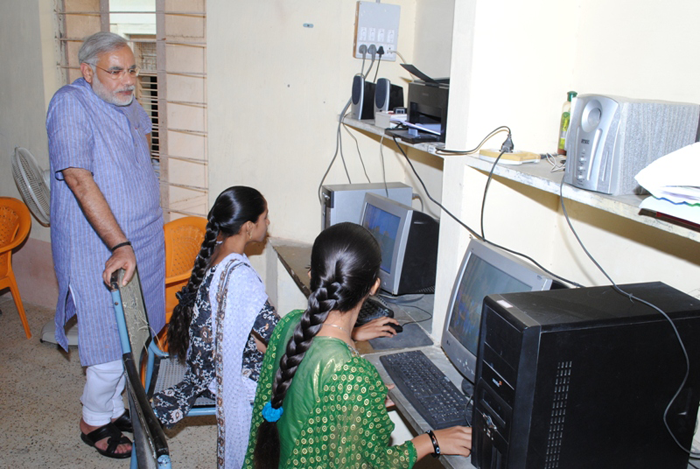
On first day of three-day-long Gunotsav, Gujarat Chief Minister Narendra Modi today reached remote villages of north Gujarat’s Banaskantha district’s Danta taluka to take assessment of schools. Modi spent time with teachers, and students in Jashwant gadh and Bhemal villages. Modi earlier visited Ambaji mandir to have darshan of goddess Amba.
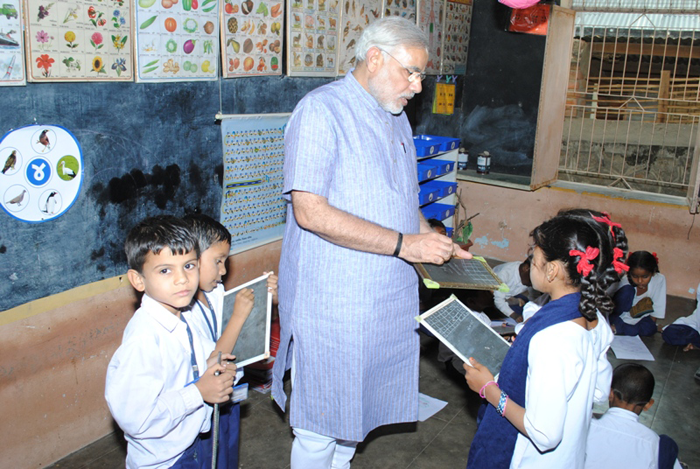
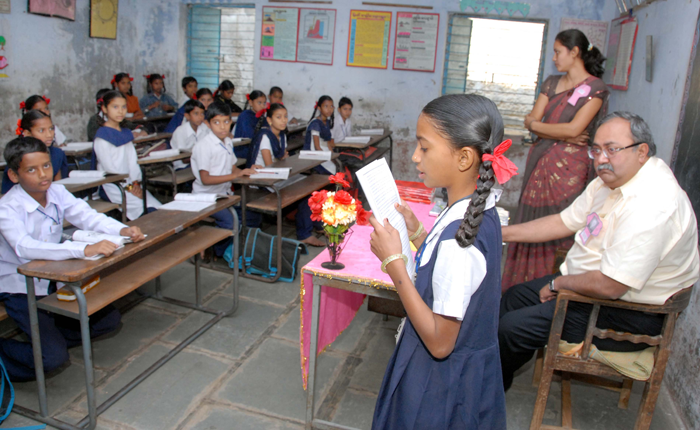
Over 3,000 class 1 and 2 govt officers of Gujarat are busy involving themselves in Gunotsav 2011 which covers around 8,000 primary schools across the state(one fourth of state’s total). They examine the quality of education and other facilities in the schools. They will give marks to each school on a computerized form available online. Officials will rate cleanliness, water, power, greenery, midday meal quality.
This is the third Gunotsav in Gujarat. In entire India there’s no gradation system for primary schools. Gunotsav is therefore Gujarat government’s initiative in this direction.
“Gunotsav is not aimed at finding mistakes and irregularities, but it is being organized for bringing overall qualitative change in schools,” Chief Minister said.
More about Gunotsava
The state government gives school enrollment festival grant of Rs 500, first aid grant of Rs 500, sanitation and cleanliness grant Rs 4800 per year, school maintenance grant of Rs 7500 for schools upto 3 rooms and Rs 15000 to schools having more than 3 rooms, school development grant of Rs 5000 for primary and Rs 7000 for upper primary schools, Rs 500 TLM grant per teacher and for std 8th new schools one time LTE grant of Rs 15000.
After Gunotsav 2009 and 2010, more qualified teachers(graduate and B.Ed) were made mandatory for upper primary education.In last two years, recruitment of 11465 language teachers and 10160 maths/science trainee teachers were made. Grades of each school, teacher, CRC, BRC, Kelavni nirikshak were conveyed to them in writing. Self assessment noticed 15% improvement after 2009 and 2010 Gunotsavs.
After Gunotsav 2009 and 2010 three-month long additional classes were arranged for students who got only 0, 1 or 2 grads in reading, writing and counting. According to UNICEF assessment of 2009 and internal assessment of 2010, most of the students showed improvement. Primary education and upper primary education, two segments were created for 1-5 and 6-8 standards respectively. Gujarat’s 10243 primary schools started std 8 classes.
Gunotsav 2011 is organized in two parts. In first part, in October 2011 state’s 33967 primary schools underwent self assessment procedure and uploaded the details on website. Questions covered conceptually understanding and application level.
In second part Gujarat’s Chief Minister, all ministers, and 3000 officials of class-1 and class-2 are in field for assessment of government primary schools. Each taluka’s about 25% schools are to be covered in this process. Each minister will cover two schools in one day, thus 6 schools in three days. Officers and board/corporation Chairmen will visit one school per day.
Schools are selected carefully. Those schools that show unusual betterment in self assessment are surely selected. There are other criteria too pertaining to selection of schools to be inspected.
NGO Pratham involved in school education will do third party assessment of Gunotsav 2011. Pratham’s representatives will visit about 450 schools during Gunotsav. Based on assessment, Pratham will also provide critical analysis of Gunotsav with suggesting points of improvement.
Recent Stories
- Diwali Food Safety Drive: AMC Seals Two Units, Fines Four Outlets ₹40,000
- HDFC Bank Gets Govt Nod to Offer Deposits Under Capital Gains Accounts Scheme
- GSSSB Announces Recruitment for 1,237 Class-3 Posts; Applications Open on November 5
- AMC to Hike Parking Fees; Proposed New Rates Here
- Mumbai Mayor Ritu Tawde Meets Gujarat CM Bhupendra Patel
- Holiday Inn Resort to Come Up in Sasan Gir