
HM Shri Amit Shah speaks in Lok Sabha on three new criminal law bills
December 20, 2023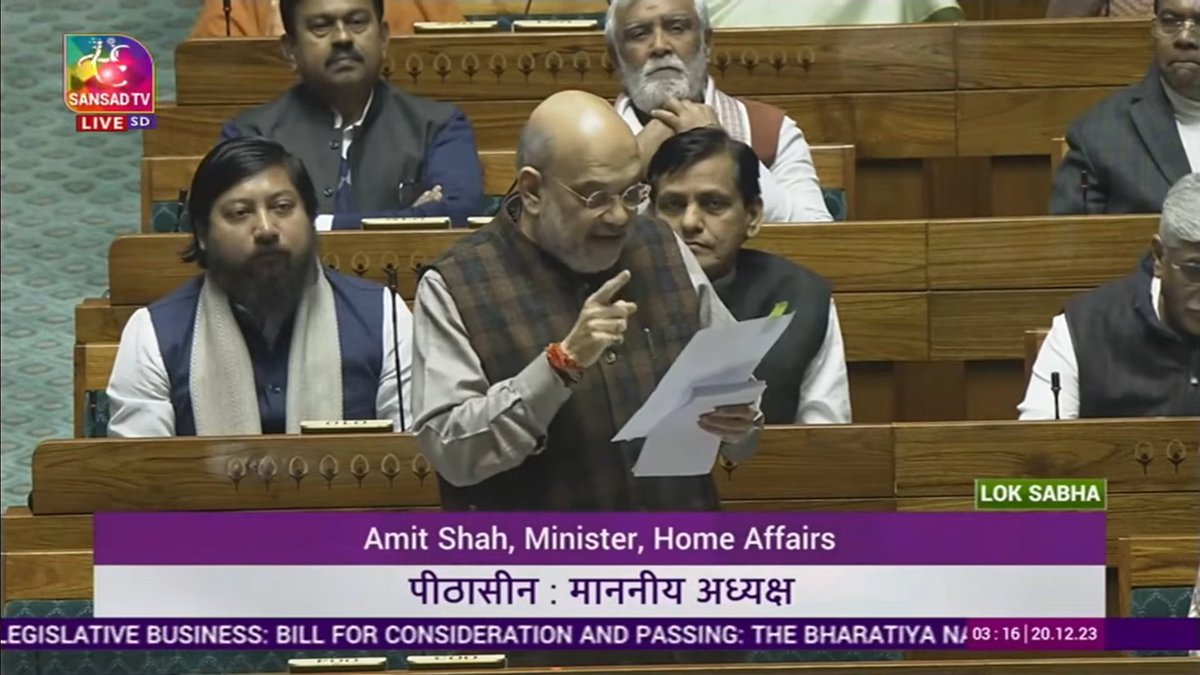
New Delhi: The Lok Sabha today passed three new criminal law bills, namely the Bharatiya Nyaya (Second) Sanhita, 2023; the Bharatiya Nagarik Suraksha (Second) Sanhita, 2023; and the Bharatiya Sakshya (Second) Bill, 2023.
Last week, Home Minister Amit Shah had introduced these three amended criminal law bills in the Lok Sabha, which will replace the IPC, CrPC, and the Indian Evidence Act.
Union Home Minister Amit Shah addressed the House on the bills, emphasizing their role in breaking free from a colonial mindset tied to laws enacted during the English rule. Shah mentioned that until these laws are repealed, UK laws will persist in the country, leading to the continued use of terms like Her Majesty, London Gazette, British Crown, and barrister terms in India.
The Bharatiya Nyaya Sanhita aims to replace the Indian Penal Code of 1860, the Bharatiya Nagarik Suraksha Sanhita is intended to substitute the Code of Criminal Procedure (CrPC) of 1973, and the Bharatiya Sakshya Bill is designed to supersede the Indian Evidence Act of 1872.
In response to discussions on the bills, Shah highlighted that the proposed laws include a precise definition of terrorism, eliminate sedition as a crime, and introduce a new section titled “offenses against the state.”
Shah emphasized that the formulation of these three bills involved thorough consultations, and he personally scrutinized every detail before presenting them to the House for approval. He criticized the existing criminal laws, including the Indian Penal Code (IPC), Indian Evidence Act, and CrPC, as reflective of a colonial mindset focused on punishment rather than justice.
The proposed criminal laws aim to establish a justice system rooted in Indian principles, aiming to free people from colonial symbols and mindset. Shah stressed that these new laws would inject a human touch into the criminal justice system, while expressing dissatisfaction with the persistence of English terms like “Her Majesty,” “British Kingdom,” “the crown,” “barrister,” and “ruler” even 75 years after independence.
Shah argued that the colonial-era laws prioritized crimes such as “looting the treasury,” “uprooting rail tracks,” and “insult to the Crown” over offenses against women and children, human rights, border security, and the army.
He highlighted changes in the categorization of crimes, such as listing rape under Section 63 instead of Section 375-376, murder under Section 101 instead of Section 302, and kidnapping under Section 136 instead of Section 359.
The bills feature provisions for harsh penalties, including the death penalty for mob lynching. Shah criticized Congress leader P. Chidambaram for questioning the government’s stance on mob lynching, asserting that those with an Indian mindset would understand the laws, while those with an Italian mindset, a veiled reference to the opposition Congress, would not.
Shah asserted that the three laws embody the spirit of the Constitution, emphasizing justice, transparency, and fairness. He highlighted the government’s achievements in fulfilling manifesto promises, including the revocation of Article 370, reduction of AFSPA in northeastern states, the ban on triple talaq, and the implementation of 33 percent reservation for women in Parliament. DeshGujarat
Recent Stories
- Diwali Food Safety Drive: AMC Seals Two Units, Fines Four Outlets ₹40,000
- HDFC Bank Gets Govt Nod to Offer Deposits Under Capital Gains Accounts Scheme
- GSSSB Announces Recruitment for 1,237 Class-3 Posts; Applications Open on November 5
- AMC to Hike Parking Fees; Proposed New Rates Here
- Mumbai Mayor Ritu Tawde Meets Gujarat CM Bhupendra Patel
- Holiday Inn Resort to Come Up in Sasan Gir