
Amit Shah Chairs Western Zonal Council Meet; Gujarat Presents GOBARdhan Scheme as Best Practice
September 07, 2026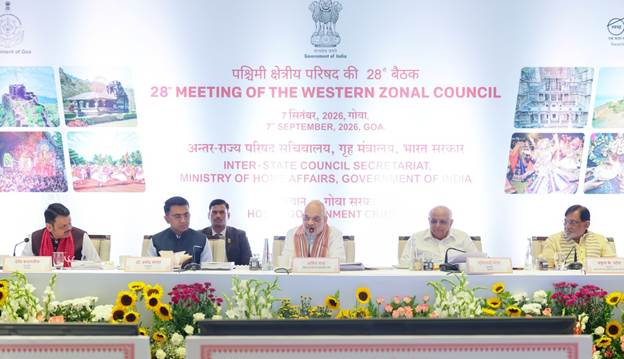
Panaji: Union Home Minister and Minister of Cooperation Amit Shah on Monday chaired the 28th meeting of the Western Zonal Council in Panaji, Goa. The meeting was attended by Goa Chief Minister Pramod Sawant, Gujarat Chief Minister Bhupendra Patel, Maharashtra Chief Minister Devendra Fadnavis, and Administrator of Dadra and Nagar Haveli and Daman and Diu Praful K. Patel.
Senior officials from the Centre, the States and the Union Territory also participated in the meeting.
Addressing the gathering, Shah said the Western Region is extremely important as it is the country’s largest economic, industrial and financial centre. He said India recorded a growth rate of 7.8 per cent in the first quarter of FY 2026–27 despite global economic turbulence, calling it a matter of pride.
Shah said the Western Region is the “WEST Engine” of India’s economic growth. He explained that W stands for wealth and finance, E for exports and ports, S for start-ups and semiconductors, and T for tourism and the blue economy.
He highlighted Goa’s contribution through tourism, high per capita income and mining. More than one crore tourists visit Goa annually, including around five lakh foreign tourists, while tourism contributes 16 per cent to the state’s GSDP. Maharashtra leads the country with 33,872 start-ups, while Dholera in Gujarat has emerged as a semiconductor hub. Mundra Port handles the highest volume of cargo, while Deendayal Port is the largest port in terms of cargo volume. Mumbai, meanwhile, continues to emerge as a major global financial hub.
Shah said the three States and the Union Territory under the Western Zonal Council have made a significant contribution to India’s economic growth. He also highlighted the role of the region in tourism, exports, ports, start-ups, semiconductors, green energy and the blue economy.
Gujarat presents GOBARdhan as best practice
As part of the best-practice sharing initiative, Gujarat Chief Minister Bhupendra Patel presented the GOBARdhan Scheme as Gujarat’s best practice at the meeting.
Patel said the scheme, launched by the Centre to turn waste into wealth, has helped promote waste management, clean-energy kitchens, pollution reduction, livelihood opportunities for women and the expansion of ODF Plus.
In Gujarat, 14,745 rural families have been covered under the household biogas plant model. These plants have resulted in annual fuel savings of Rs. 36.86 crore and reduced carbon emissions by more than 12,800 metric tonnes annually. The 3.81 crore litres of bio-slurry generated each year has also supported organic farming and reduced dependence on chemical fertilisers.
Patel said the Centre, under the leadership of Prime Minister Narendra Modi, has approved the Rs. 23,700 crore GOBARdhan Scheme to boost Compressed Biogas (CBG) production in the country. Gujarat, he said, is committed to achieving the goal of turning waste into wealth at the household, industrial and community levels under the CBG Mission.
Zonal Councils focus on implementation
Shah said Zonal Councils have evolved from forums primarily focused on dispute resolution into instruments for monitoring the implementation of public welfare schemes. He said there are no longer any disputes among the States in the Western Region, calling it a major achievement.
He said the councils are also monitoring issues such as child malnutrition, underweight and stunting, Aadhaar penetration and the implementation of Ayushman Bharat cards. Several inter-State river disputes have also been resolved through the Zonal Council mechanism.
Shah said the Western Region should play a leading role in implementing the new criminal laws and strengthening India’s fight against drugs. He also highlighted progress in the computerisation of Primary Agricultural Credit Societies (PACS), with Maharashtra achieving 98 per cent and Gujarat 92 per cent.
He urged States to adopt the Gobardhan model established by Banas Dairy.
Shah said Prime Minister Narendra Modi is continuously monitoring the strategy against cybercrime through PRAGATI. He called for connecting all Urban Cooperative Banks with the Financial Cyber Fraud Reporting and Management System (FCFRMS), encouraging cooperative banks to integrate with MuleHunter AI, and ensuring their connection with the Indian Cyber Crime Coordination Centre (I4C).
He also said the Ministry of Home Affairs will focus seriously on strengthening coastal security over the next two years.
Shah further said the four members of the Western Zonal Council are leading the country in green energy and urged them to take maximum advantage of the Centre’s policy for data centres.
Key issues discussed
The 28th meeting discussed several issues concerning the member States and the country, including the implementation of Fast Track Special Courts for speedy investigation and disposal of rape cases involving women and children, the Emergency Response Support System (ERSS-112), food safety standards, Ayushman Bharat–Pradhan Mantri Jan Arogya Yojana, banking facilities within the prescribed radius of every village, railway development projects and environmental clearances.
Issues of national importance, including urban master planning, electricity supply, strengthening PACSs, eliminating child malnutrition through Poshan Abhiyaan, reducing school dropout rates, increasing participation of public hospitals in Ayushman Bharat and strengthening cybercrime and digital infrastructure, were also discussed. DeshGujarat
Recent Stories
- Ahmedabad to Get Rs 307 Crore Vande Bharat Train Maintenance Hub at Sabarmati
- Ahmedabad Police Nab Rajasthan Duo for Selling Fake Garba Passes on Instagram
- 2.1 Kg Ganja Seized at Ahmedabad Airport; Passenger, Receiver Both Held
- ‘Gen Z’ IPS Officer Annu Tatu Transferred to Gujarat Cadre
- Gujarat Deputy CM Harsh Sanghavi on Japan Visit
- Gujarat Govt Orders Criminal Action Against Contractor Over Poor Bridge Construction Quality