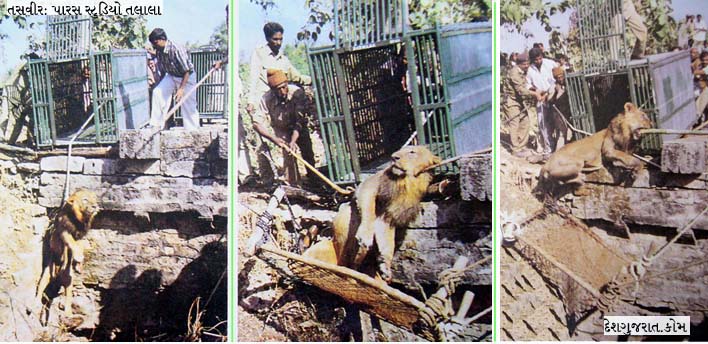
Where is the will power to protect Gujarati lions ?(Multi)

There are around 4000 open wells without any wall or fencing in and around Gir forest area, only habitat left for Asiatic Gujarati lions in the world. This is really very serious situation because every year mostly in December, in different incidents, lions fall down in the wells and if particular well is not dry (has water in it) or if local farmer comes to know late about it and therefore lately inform local forest department, there are chances that the lion is dead in that case.
In last three years at least half a dozen lions have died. There are now only 359 Asiatic Gujarati lions left in the world and we can not afford even a single death due to human negligence. How can we afford 4000 open wells which are like death traps for lions?
Local people can be motivated to do fencing or wall around wells, or government should pass a strict law and should make this mandatory. Why there isn’t such a law? There was huge budget available for Gir lions under IFDP scheme and Eco development project but why under this hefty budget help programs, this work was not done?
When forest department gets a call about lions felled in some well, a team reach to the spot and rescue a lion with great difficulty, danger and efforts but sometime this is not helpful when team reach late or when there is a water in well. Lion face great psychological trauma in such efforts too and may die from a shock after the rescue. All needed is a good law with great enforcement. This can be a top down idea but even at bottom up level villagers must be awakened to make fencing or wall around their wells to make lions live longer and safer.
We have to decide that whether we want to give Gir Gujarati lions to our next generations in a living form, or in the form of pictures in storybooks and skeletons in museums? Where is the will power?
Also watch:Leopard in Vadodara’s Bathroom(video)




December 22nd, 2006 at 11:38 am
Story of the Lion of India
Asiatic Gujarati Lion, Panthera leo persica species account
Asiatic Gujarati lion fast facts and vital statistics
Historical range:Past and present distribution of the lion in North Africa and Southwest Asia
Survival threats to the Asiatic Gujarati lion
The Asiatic Gujarati lion captive breeding programme
Asiatic Gujarati lion breeding photo gallery
History:Asiatic Gujarati lion
Population:Asiatic Gujarati lion
Breeding program: Asiatic Gujarati lion
Gir century for Asiatic Gujarati lion: Area
Gir century for Asiatic Gujarati lion: Approach
Gir century for Asiatic Gujarati lion:Location, topography & Geomorphology
Gir century for Asiatic Gujarati lion:Climate
Gir century for Asiatic Gujarati lion:Water resources
Gir century for Asiatic Gujarati lion:Floristic
Gir century for Asiatic Gujarati lion:Floristic:Fauna
Asiatic Gujarati lion:Photo gallery
Gir century for Asiatic Gujarati lion:Mammals
Gir century for Asiatic Gujarati lion:Reptiles
Gir century for Asiatic Gujarati lion:Wild life census data of Gir
Gir century for Asiatic Gujarati lion:Photo gallery of other animals
Gir century for Asiatic Gujarati lion:Gujarat Forest department’s official page
December 22nd, 2006 at 1:48 pm
Sad and shocking. Wonederul story. Government must do something.
December 22nd, 2006 at 3:14 pm
You rightly said, there can be top down and bottom up both kind of solutions. But I think top down is easy way out.
December 23rd, 2006 at 7:48 pm
very sad. has anyone tried to figure out the cost of fencing or covering up the wells and approached any animal wellfare agency such as World Wildlife Foundation? Something need to be done.
Kanchan,
Toronto, Canada
December 25th, 2006 at 9:17 am
There are several other issues too which are to be adressed about protection of lions in Gir. Government and peoples’ efforts are less than they should be about this issue. Deshgujarat, please give more episode about wildlife related issues. Nobody talks about them.
December 26th, 2006 at 8:47 pm
We should email gujarat government for this. I have mailed already.
December 28th, 2006 at 6:11 pm
Very sad story, I am in a quest about what I can do in this situation, if I mail chief minister will it produce any result ? and I liked that you used the words ‘Gujarati lions’, yes thats the correct word.
December 29th, 2006 at 9:24 am
Realy serious issue. If you are interested, also read these related stories
Related reading:3000 open wells around Gir threaten lions
http://timesofindia.indiatimes.com/articleshow/322815.cms
Related reading:Wells, fences are Gir lion’s new enemies
http://timesofindia.indiatimes.com/articleshow/1274706.cms
January 10th, 2007 at 8:13 pm
Lion population in Gujarat is total 359- 2005
Gir reserve area 291
Gir forest area 017
Coastal areas 012
Matiyala century, SavarKundla, Amreli and Bhavnagar district 039
- Last year in Ocotber when high power meeting about wild life of Gujarat was held(Chief minister was present) Decision came about establishing a new eco lion safari park near Ambaradi village at Dhari area of Amreli. Here there is a waterfall of Khodiyar also which makes tourist friendly enviornment. Gujarat state wild life advisory board has aproved this concept.
- Recently forest department of Gujarat has declared that they will shift 10 to 12 lions in Barda hill forest area within one year and in next five years Gujarat government will spend 60 crore Rs. for setting up new areas for Lions.
———————————————————————————————————————–
Three videos from camera person Prashant Patel, recently uploaded on google video.
Gir Lion 21 sec
4 lionesses and a lion
1 lioness
January 19th, 2007 at 10:24 pm
I urge people to look at this website : http://www.nationalgeographic.com/ngm/0106/feature3/
January 20th, 2007 at 6:45 am
Read 6 January 2007 Indian express article:
Lion electrocuted in Gir, case filed against farmer
http://cities.expressindia.com/fullstory.php?newsid=216377
———————————————————————————————————
Also submitting this video about lion watching in Gir forest. Enjoy it………..
January 20th, 2007 at 4:08 pm
Wonderful video from http://www.youtube.com/profile?user=neofelisman on Youtube about Asiatic Gujarati Gir Lions
January 22nd, 2007 at 3:12 am
This is indeed very sad
January 22nd, 2007 at 7:28 pm
Great videos(from google video)which truely show majesty of Gir forest as well as Gujarati lion. Language is French but no problem with that, just enjoy visuals. They are stunning.
February 2nd, 2007 at 11:11 am
Gujarat’s forest ministers talked with reporters on lion issue: This is Indian express story about it
Gir lions to find new abode at Barda Hills
Gandhinagar, January 31: In a tactical move which may water down the argument to shift the Gir lion to Madhya Pradesh, the State Government has decided to introduce big cats to the region of Barda Hills lying between Porbandar and Jamnagar.
Declared a sanctuary sometime ago, the 192.35 sq km of undulating terrain resembles Sasan, but is yet to get its share of lion population.
“We would be introducing five pairs of lion in the next few months in Barda,” said State Forest Minister Mangubhai Patel addressing newspersons at his office on Wednesday.
The State Forest Department had proposed Barda as an alternative site for the expansion of home for the Asiatic lion. As a preparation for this, breeding centre for antelopes and hare was started sometime ago. The region already has a healthy population of blue bull and wild boar.
Though the population of lions from Gir has spread outside Sasan (Junagadh) to satellite areas of Mitiyala, Girnar, and Hipavadi, the cats in these regions have always been connected with the main population in Gir sanctuary.
With Barda at a distance of 130 km with no corridors to Gir, it would help develop and independent lion region in the State, said officials, adding that given the emotions involved, no one in the State is ready shift lions to MP.
“The shifting of lions to MP has failed twice in 1974 and 1981. The government is not ready for another chance,” said a senior official.
The minister said apart from Barda, the area between Savarkundla and Mahuva spread over 125 sq km too was being strengthened as a lion habitat. As of now, Asiatic lion population is spread over 1450 sq km in the State, with the last census pegging the figure at 359.
Link:http://cities.expressindia.com/fullstory.php?newsid=220096
February 10th, 2007 at 5:43 pm
Lion attacks three in a village of Bhavnagar
Saturday, February 10, 2007 (Bhavnagar):
A lion on Saturday attacked and injured three persons, including a woman, in a remote village of Gariadhar taluka of Gujarat’s Bhavnagar district.
The incident occurred this morning, when a male lion attacked people inside a farm in Motiwavdi village.
The injured have been identified as Dhula Virani, Hitesh Darji and Paliben Kirtan.
Two of these three have been brought to the civil hospital in Bhavnagar for treatment, sources at the hospital said.
The victims bore injuries caused by the claw of the lion, they added.
February 11th, 2007 at 5:49 am
A sanctuary for whom?
India’s forgotten tribes gain rights over forests but some fear that they will poach wild animals and degrade the habitat.
Story published in Malayshia’s ‘ The Star ‘
http://thestar.com.my/lifestyle/story.asp?file=/2007/1/30/lifefocus/16461485&sec=lifefocus
February 11th, 2007 at 8:21 am
—– Forwarded Message —-
From: Atul Singh Nischal
To: tigerfire@yahoo.com
Sent: Thursday, November 16, 2006 2:41:39 AM
Subject: Thousands of OPEN DEATH WELLS surrounding GIR Forest killing the last Asiatic Lions; Another big cat (wild Asiatic Lioness) meets watery grave
****************************
LOOKS LIKE THERE ARE NOT hundreds BUT “THOUSANDS (1000s)” of
OPEN WELLS / “DEATH WELLS” IN AND AROUND GIR FOREST that have been regularly killing & swallowing “the last wild Asiatic Lions” and other wildlife and the Government only talks, talks & talks, but does nothing…..
while the world’s last wild purebred population of Asiatic Lions will continue to be killed on a regular basis as has been going on for decades and their precious gene pool will continue to diminish right before our eyes.….
+++++++++++++++++
If the farmers, Gujarat or the Central Indian Government can not fill/cover-up these thousands of “Open wells” / “Death wells” and also provide the much needed subsidized “TUBEWELLS” to the farmers instead and ban any new open wells, then it is time that international funds are raised for this……… also former Asiatic Lion countries ought to be targeted……….. but they might have to be jolted out of their indifference and made to realize that these very Asiatic Lions once not so long ago also called their country home.
It is also now high time to shift 2-3 prides of these wild Asiatic Lions to Kuno-Palpur Wildlife Sanctuary in the neighboring Indian state of Madhya Pradesh (MP) for this reason too amongst several others. This Sanctuary has been chosen scientifically as a former habitat of wild Lions and has been developed as an ideal site for their reintroduction to build the second wild Asiatic Lion population. A forest belt of about 3000 Square Kilometers surrounds this Sanctuary where the future population of these re-introduced Lions can expand into in the centuries to come thus reclaiming some more of their lost territory.
It is very unfortunate that the Indian state of Gujarat where the last wild Asiatic Lions live have almost declared them a state property and continue to refuse any translocation plan outside of the state in spite of the warnings of wildlife experts to start a second removed population for genetic diversity and guarding them against any epidemics etc. It looks like Gujarat wants to selfishly maintain their state monopoly over all the Tourism revenue these last remaining wild Asiatic Lions of world generate for them. It is high time they educate themselves of the real long term survival needs of their Lions and let go of some happily for reintroduction to Kuno-Palpur Wildlife Sanctuary in the neighboring Indian state of Madhya Pradesh (MP). Thousands of Asiatic Lions lived in MP for thousands of years along with Tigers till about 150 years ago before they were driven to extinction by Man armed with ever more modern weapons like elsewhere in India, Iran, middle east and Europe.
atulsinghnischal@yahoo.com
*******************************
DEATH WELLS surrounding GIR Forest killing the last Asiatic Lions left on earth and driving them ever faster to their extinction?
Who will “fill”, “enclose” and “outlaw” the thousands of DEATH WELLS surrounding GIR Forest killing the last Asiatic Lions left on earth and driving them ever faster to their extinction?
Another Wild Asiatic Lion Death by falling into an “open village well” reported, several thousand such hidden wells in the grass and undergrowth dot surrounding terrain around Gir Forest. Who will “fill”, “enclose” and “outlaw” these hundreds of DEATH WELLS surrounding GIR Forest killing the last Asiatic Lions left on earth and driving them ever faster to their extinction? These are death traps for unsuspecting wildlife including the last 300 or so wild Asiatic Lions of the world living only in the Gir forest and the surrounding terrain.
My suggestion is that the government should excavate much needed dry season “saucer shaped water holes” for wildlife all over the Asiatic lion range and the soil excavated from these can be used to fill up ancient unnecessary open wells. Modern Tube wells which pose no threat to wild Asiatic Lions or other Wildlife can be dug for the farmers if needed.
“Saucer shaped water holes” excavated for wildlife will also serve to conserve rain water from runoff which can slowly seep down to the water table recharging it to the village farmer’s delight and the general health of the ecosystem.
It is simply absurd to tolerate such mortality inflicted upon the very last critically endangered wild population of Asiatic Lions left on earth. “OPEN WELLS Threat” has been well documented now for the past many years; several hundred wild Asiatic Lions have been maimed or killed by falling into them down the decades, its time the Government is pressurized to act.
The Government should map the position of all such wells in Gir and all surrounding area, specially the Asiatic lion dispersal area outside Gir Forest and straight away fill all deserted / abandoned wells as suggested above and “outlaw all open wells” in the whole region. If farmers intend to keep many of these wells they and the government should construct parapets and cover these wells, the Government should encourage farmers to go for subsidized tube wells instead which are no threat to wildlife.
Atul Singh Nischal
atulsinghnischal@yahoo.com
**NEWS:**
“Another big cat meets watery grave”
Sibte Husain Bukhari
Junagadh, November 1, 2006: Another open well became a watery grave for a big cat in Gir. A 14-year-old lionesss died in Pachpachiya village near Tulshishyam range in Gir east after reportedly falling into a well about 100 feet deep. The time when the animal fell into the well — which did not have a parapet — is yet to be ascertained. The well is located on a farm belonging to one Nathabhai Gohil. Gohil, on noticing the carcass floating in the well on Tuesday, immediately informed forest officials along with the village sarpanch. Range Forest Officer (Tulsishyam) rushed to the spot and got the dead animal fished out. Forest officials are speculating that the animal would have fallen into the well two days ago.
A panel of doctors at Junagadh’s Sakkarbagh Zoo on Wednesday night carried out a post-mortem on the carcass. When contacted, zoo doctor C N Bhuva said the lioness had died due to drowning.
When contacted, Deputy Conservator of Forest (Gir east) S P Sisodiya said, “There is no sign of any external injury on the animal’s body. Also, 15 claws were found to be intact. Prima-facie, it is case of an accidental death.”
Sisodiya has appealed farmers to construct parapets or cover wells without them or fence them to avoid death of lions.
http://cities.expressindia.com/fullstory.php?newsid=207725
**NEWS:**
“3,000 open wells around Gir threaten lions”
Himanshu Kaushik
[ 5 Nov, 2006; 0137hrs ISTTIMES NEWS NETWORK ]
AHMEDABAD: Over 3,000 open wells in and around Gir sanctuary continue to pose a threat to Asiatic lions. Every year, at least 12 to 15 lions or leopards fall into open wells and on an average, four to five of them die, say forest officials.
With open wells posing a grave danger, the forest department recently carried out a survey and discovered over 3,000 wells which didn’t even have parapets.
Junagadh collector Ashwini Kumar said, “The collectorate has taken stock of the situation and we are planning to work out a strategy to cover these wells.”
The estimated cost of covering these wells will be around Rs 10,000 per well. Since huge funds are involved, the forest department has already moved a proposal.
Kumar said that the department can issue a notification asking farmers to cover the wells, but this can’t be made compulsory.
Bharat Pathak, conservator of forests, said, “This is a costly affair.We have covered a large number of wells in western Gir, but many more remain uncovered. We have also undertaken several awareness campaigns in the area and are telling the people that open wells pose a threat, not just to animals, but to human life as well.”
Pathak said that many NGOs have come forward to cover these wells, but the effort put in by them is inadequate as these basic safety measures require huge expenditure.
According to Pathak, the problem of open wells is difficult to tackle as villagers in this arid zone dig up fresh wells when required and leave these uncovered once the water dries up.
Former chief conservator of forests, G A Patel, feels that the problem has been persisting for too long and a long term solution has to be found.
Patel had proposed that for all wells, within a radius of 10 km from the sanctuary, should be compulsorily surrounded by parapets which are at least five feet in height.
http://timesofindia.indiatimes.com/articleshow/322815.cms
**NEWS:**
“Wells turn death traps, foresters helpless”
Brahmananda Shasmal
Ahmedabad, November 8, 2006: * NOVEMBER 1:A 14-year-old lionesss died in Pachpachiya village near Tulsishyam range in Gir East after falling into a 100 feet-deep well.
* OCTOBER 30: A lion was found dead in a blind well in Gir sanctuary area.
* OCTOBER 22: A leopard was found dead in a blind well (without parapet walls) near Talda village of Khamba taluka on the outskirts of Gir sanctuary
These are few of the several incidents where the wild cats of Gir met a watery grave. While the Forest Department is raising a hue and cry about a chinkara being filmed during the shooting of Lagaan eight years ago in Kutch, they are silent about the fact that the wild cats are meeting their death after falling into open wells around the Gir Sanctuary — sole abode of the Asiatic lion.
‘‘Every year there are at least 15 such deaths,’’ says Amit Jetva, president of Gir Nature Youth Club. ‘‘There are more than 6,000 blind wells within a 6 km-radius of the sanctuary’s borders. The number of wells has gone up in the past couple of years. Saurashtra is an arid zone where farmers dig wells for irrigation purposes. But these are the very areas that fall in the lion’s migration path. So the Forest Department as well as the State Government should take an initiative to protect these wild cats, which are the pride of the State and nation as well,’’ he says.
Forest officials say lions and leopards usually fall into the blind wells while hunting at night. In pursuit of stray cattle or other prey foraging in the fields or farms on the sanctuary’s periphery, they often fall into these wells and drown before anyone can even spot them.
As more land comes under cultivation around the Sanctuary, the number of blind wells are rising, posing a threat to wild cats.
Sadly, except for appealing to the farmers to cover the wells, there is nothing much that the Forest Department can do as their jurisdiction does not cover these revenue areas.
Pradeep Khanna, Chief Conservator of Forests (Wildlife), says, ‘‘We have left no well uncovered within the sanctuary area. There are over 6,000 wells on the periphery of the sanctuary and these are on private land. In these areas, we are requesting farmers to cover these wells or erect some visible barriers so that wild cats can be prevented from falling into these wells.’’
He said, ‘‘It’s not that the Forest Department is doing nothing to save the wild cats. There were several incidents where our staffers had rescued animals from wells.’’
“We cannot prevent such deaths as the lion migration area is vast. We can help farmers to construct parapets, cover wells or create visible barriers, but we cannot lend financial assistance to all farmers to construct parapets. There are some motivating NGOs, who have offered to help farmers construct parapets and pile up wooden brush over the well,’’ says Bharat Pathak, conservator of forests, Junagadh, adding, ‘‘If the farmers can dig wells at a cost of Rs 40,000 to Rs 50,000, they can afford another Rs 2,000 to construct parapets over the wells.’’
When asked about the death of lions, Minister of Forest and Environment Mangubhai Patel says, ‘‘Every state should make provisions for the development of sanctuary area. It is sad that lions are dying in this manner. However, figures also reveal that there has been a rise in the number of lions. Now, there are 359 lions in the sanctuary.’’
To prevent such incidents, Jetva has a solution.
‘‘All it requires is proper legislation. People in lion migration areas must be forbidden to construct wells. There are more than 150 lions in non-protected areas. That lions are dying in this way just shows how careless the authorities are,’’ he says.
http://cities.expressindia.com/fullstory.php?newsid=208893
+++++ Just 2 Months before ++++++
*************************************************************
**NEWS:**
“Lions that fell into well rescued” (Wild Asiatic Lions at Gir Sanctuary)
Junagadh, August 23, 2006 By: Sibte Husain Bukhari
Junagadh, August 23: A young lion pair that fell into a 60-ft deep well was rescued successfully and without them suffering any injuries on Wednesday. In a separate incident a lioness that was under treatment at Jasadhar Animal Care Centre, falling under Dhari-range forest headquarter in Gir east forest division, died on Tuesday. The big cat, about 10 years old was under treatment for the past one and a half months.
Meanwhile in the rescue operation that occurred on Wednesday, forest sources said that a young lion and lioness, aged two and a half and one and a half, reportedly fell into a well located in an agriculture land owned by a farmer identified as Lakhabhai. The incident occurred at around 9 am at Dedans village near Tulsishyam forest range. Lakhabhai immediately informed forest officials about this, who rushed to the spot immediately and started the rescue operation.
When contacted Deputy Conservator of Forest (Gir east) S P Sisodiya said that lion couple was rescued unhurt and kept under observation. The duo will be released soon in their territory with their group, he said. “The well that had no enclosure was 20 feet in diameter and had water 45 feet below. The rescue operation therefore was highly risky but our rescue team experts managed to save the animals’ lives,” Sisodiya said. Hundreds of wells without boundary walls in Gir area have been posing a huge threat to the wild animals. Forest department has repeatedly appealed to farmers to cover such wells, Sisodiya said.
About the lioness’ death, Sisodiya said the animal was very ill and under medical treatment. Meanwhile in Khambha taluka’s Badadhar village in Amreli district, a python was found trapped in a well and later rescued while the carcass of a crocodile was found from the riverside located at Raval Dam catchment area near Chikli kuba village.
http://cities.expressindia.com/fullstory.php?newsid=198091
**********************
**NEWS:**
“Male lions rescued from well in Amreli”
VADODARA, [ 24 Aug, 2006 0651hrs IST PTI ]
VADODARA: Two male lions that had fallen into a 50-feet deep well in a village of Amreli district in Saurashtra were rescued on Wednesday, officials said here.
“After about five hours of successful rescue operation, both these lions were rescued and have been kept in a cage. They are being looked after at present”, Gir Forest range officer Bharat Pathak said.
He, however, said that they were unaware as to how both these lions fell into the well and the matter was being investigated.
However, wildlife activists from nearby Amreli district said some locals staying in Bedan and surrounding villages had started pelting stones at these wild animals two days ago after hearing their roars late at night.
The activists said the lions had fallen into the well as it was dark.
http://timesofindia.indiatimes.com/articleshow/1921310.cms
************************
—– Forwarded Message —-
From: amit jethwa
To: nathistory-india@Princeton.EDU (NATURAL HISTORY & CONSERVATION INDIA, EMAILING LIST)
Sent: Friday, August 25, 2006 5:00:46 AM
Subject: open wells turn death well for Asiatic Lions and other wild animals…
We came to know from farmer of Dedan village of Khambha taluka that lion pair felt in well and live on morning of 23/08/06 . Urgently informed to concern forest officials for resque.
Asistant Consevator of Forest , Gir East Division with concern Range Forest Officer - Tulshishyam reached on spot and saved lion and lioness pair. Officials diclared that both will release in Gir PA within short time.
Lions was aroung 2.5 year and lioness was around 1.5 year old. The well was without of any parapat wall. About 8-10 such incidenced occured during a year and many incidences became hazardous for wild animals. About 10 thousands such well falls in Asiatic Lions corridor area. There should be some legal provisions for open well in Asiatic Lion corridor. Forest Authority should focus on Open Well enclosure in Eco - Development Fund. Approximately 32 crores rupees spent for Gir Eco Development Project but no initiatives were taken for open well.
The Conservator of Gir PA sicked in his seat since last 6.5 year, may be record in India . About 150 lions deaths reported during his tenture. He is totally failed to manage Gir PA properly. Urgent requirement for transfer of Gir PA CF.
amit
Amit B. Jethava
President
Gir Nature Youth Club
Gujarat State
At:Khambha, Di: Amreli
Pin:365650( Gujarat ) India .
Telaphone:02797-260121,260182
Telefax:02797-260182
Mobile :+91 94 269 38812
Email: amitjethava@hotmail.com
amitjethava@rediffmail.com
amit_jethava@yaoo.co.in
*************************************************************
**NEWS:**
“Gir lions on the verge of extinction”
By: Bahar Dutt, CNN-IBN, Posted Tuesday , January 17, 2006 at 19:03
ROARING FOR ATTENTION: The Asiatic lion in India is on the verge of extinction, but it’s cry for attention is being ignored.
*** Watch the Video: ***
http://www.ibnlive.com/videos/3872/gir-lions-on-the-verge-of-extinction.html
Here is CNN-IBN’s ‘post-mortem’ report.
* Uncovered wells are death traps for the lion. Documents are littered with reports of lions claimed by these wells.”…..
(Article continuous……)
News Source IBNlive:
http://www.ibnlive.com/news/gir-lions-on-the-verge-of-extinction/3872-3-0.html
*************************************************************
ASIATIC LION – “LINKS”
*”The Asiatic Lion Information Centre”, The home of the European Asiatic Lion Breeding Programme.
The purpose of the Asiatic Lion Information Centre is to serve as a central point on the Internet for information about Asian lions. Here you will find historical information about the Asian lion, a species account, range maps, and information about the conservation programmes being undertaken to secure the survival of this species of big cat. www.asiatic-lion.org/credits.html; Please remember to also visit the News pages (1997 onwards)
www.asiatic-lion.org/index.html
*Asiatic Lion Protection Society (ALPS) (a group Wildlife enthusiasts) from Gujarat , India
This site is developed by Gir & Asiatic Lion Protection Society (GALPS) (a group Wildlife enthusiasts) purely with intention of spreading information of Asiatic Lion and Gir. This site is still under development. A whole new concept, new topics, new material, photographs, video clips, sound clips, News Articles etc. will be uploaded by October 2006. If you have any comments or content please write to us at info@asiaticlion.org.
www.asiaticlion.org/
*Blog on Latest News articles on Asiatic Lion and Gir by GALPS, Gir & Asiatic Lion Protection Society (GALPS) (a group Wildlife enthusiasts), Blog created by Kishore Kotecha, Rajkot INDIA i.e. one of their founding memebers:
http://asiatic-lion.blogspot.com/
*Asiatic Lion Forum of “National Geographic” International
Forum relating to following Article: “Asia’s Last Lions: National Geographic. Extinction stalks the Asiatic lion, a regal subspecies now crowded into a single sanctuary in India ’s Gir Forest “.
Aticle and Links: www.nationalgeographic.com/ngm/0106/feature3/index.html; http://mesa.nationalgeographic.com/ngm/cgi-bin/forum/forum.cgi?forum=asiatic_lions
*Asiatic Lion Forum of “Times of India” Newspaper local Gujarat office.
Should some Gir lions be shifted out of Gujarat ? What is the symbol that represents the pride of Gujarat ? It has to be the majestic lion of Gir - the only natural home the Asiatic lion has in the world. It is not surprising therefore that the Gujarat government is fighting tooth and nail against a move by the Centre to shift some of the lions to a sanctuary in Madhya Pradesh. Gujarat is not ready to give up its exclusivity over the animal and has instead suggested that if the lion needs another home outside the congested Gir, then it can be within Gujarat itself. Conservationists are united when it comes to the need to have an alternate home for the lion so that its gene pool can be protected and its population be encouraged to grow again in areas other than Gujarat where it once ruled the forests till it was edged out by the tigers and humans. While some such attempts in the past have failed, others say Gujarat ’s pride is not as important as preserving the lion. Should some Gir lions be shifted out of Gujarat ? Robin David, TOI Ahmedabad ( Gujarat ) Bureau. (Atul’s Note: To educate yourself on the issue please visit “The Asiatic Lion information Centre” The home of the European Asiatic Lion Breeding Programme and its News pages: www.asiatic-lion.org/index.html
http://o3.indiatimes.com/mytimes/archive/2006/06/21/835722.aspx
*IRAN-ZOO Page on Asiatic Lion
Persian (Asiatic) Lion - Page, (Panthera Leo Persica), Shir (in Persian); Asiatic Lions have been extinct in Iran since 1942
http://iranzoo.tripod.com/lion/lion.html/
*Yahoo Group on Asiatic Lions
Please Join Us if you really care for Asiatic Lions
Help us Save this “Critically Endangered” species, “The Asiatic Lions”, from Extinction. Please join us in our efforts to raise the awareness, and spread the news, of CONSERVATION. Help Save the Asiatic Lions.
http://pets.groups.yahoo.com/group/Asiatic_Lions/
February 14th, 2007 at 4:37 am
**NEWS**
“Another safety net for lions in Gir”
Bashir Pathan; Wednesday, February 14, 2007
Gandhinagar, February 13, 2007: It’s a roar of a move by the Gujarat Government. In a bid to mobilise additional resources for conservation of Asiatic Lion and its associate flora and fauna in the Gir National Park and adjoining areas, the State Government has decided to set up a separate autonomous body called “Gujarat Lion Conservation Society” to be registered under the Indian Societies Registration Act (XXI), 1860.
The other main functions of the Society will be to mobilise and provide all necessary inputs for the protection and management of Gir and adjoining meta-population of Asiatic Lions, and also facilitate the development and maintenance of captive gene pool at selected sites in and around the Gir forests.
“ State Forest and Environment Minister Mangubhai Patel has already cleared the file containing a proposal to form the Society. As soon as a government resolution (GR) on this is issued, expectedly sometime this week, we will initiate the process of getting the Society registered under the Indian Societies Registration Act”, sources in the State Forest Department said on Tuesday.
Confirming this development, State Forest Minister Patel told The Indian Express,”The decision to set up the Society assumes a great significance in the wildlife area, for it will not only help protect and conserve the Asiatic Lion in Gir and its expanding territory, but also fetch funds from the national as well as international agencies like the World Wildlife Fund (WWF) and Switzerland-based International Union for Conservation of Nature and Natural Resources (IUCNNR) for conservation and protection of Big Cats”.
Under the autonomous body, the Forest Department will carry out research activity for conservation of the Big Cat and its habitat, and also launch eco-development, eco-tourism and conservation awareness programmes. It will generate funds through the various sources : membership fees, donations, endowments, bequests, gifts, contributions, adoptions etc from/by national and international agencies, grants (both recurring and non-recurring) from the State and Central Governments and local self-government bodies.
There is also provision for individual and institutional membership of the Society, with annual and life membership fees for an individual being fixed at Rs 250 and Rs 5,000, and Rs 10,000 and Rs 1 lakh for institutional member in that order. Any Indian citizen, and institution, corporation, company or organisation constituted under relevant laws and interested in pursuing and promoting the objectives of the Society shall be eligible for its membership, informs a senior Forest official.
The Society will have a 16-member executive committee under the chairmanship of a Chief Conservator of Forests and Chief Wildlife Warden, while the Conservator of Forests, Wildlife Circle (Junagadh) will be its member secretary and chief executive officer (CEO).
The government will also nominate two NGOs on the committee that will be empowered to collect and/or generate resources and funds on behalf of the Society, and will also coordinate and exercise supervision of its activities.
The total area of Gir Lion National Park and Sanctuary is 1,412 sq kms, which is the habitat for as many as 359 Asiatic Lions. Keeping in view the number of Big Cats increasing every census, the government has decided to expand the their home territory, with 192 sq kms of the Barda forests and hilly terrains having already been identified and earmarked as additional habitat for lions.
“At present, the Forest Department gets only about Rs 4 crore per year from the State Government, and another Rs 40 lakh from the Centre to maintain the Gir National Park and Sanctuary.
Over half of the funds goes into the recurring expenditure, including the salaries of about 300 forest staff employed there. This is too meagre an amount to carry out protection and conservation activities in the Girl forests - the only habitat for Asiatic Lions.
Hope, the Society will help the department generate adequate funds”, explains a senior official.
http://cities.expressindia.com/fullstory.php?newsid=222267
February 16th, 2007 at 4:47 am
VANISHING HERDS FOUNDATION COMES TO THE RESCUE OF ASIATIC LIONS, VULTURES & OTHER WILDLIFE:
** NEWS **
“Man-animal conflicts? Vanishing Herds to rescue”
GIR: Foundation’s project to barricade wells in Amreli already on
D P Bhattacharya
Ahmedabad, February 15, 2007:
TO reduce mortality rate of Gir’s Asiatic lions and bring down frequency of man-animal conflicts, the State Forest Department and the Vanishing Herds Foundation (VHF) have come up with a number of measures keeping in mind the concerns of locals living in the vicinity of the Gir Sanctuary.
According to VHF governing body member Arobinda Sinha Roy, the VHF has begun a project to construct barricades around open wells in Amreli district. “Open wells in Saurashtra region do not have protective walls around them,” said Sinha Roy adding that in recent years, 20 lions and cubs have died after falling into wells. The project began in 2006. So far, we have barricaded 12 wells in Amreli district. By March 2007, we hope to complete barricading at least 100 wells. After that, we will focus on barricading 250 wells every 12 months,” said Sinha Roy.
The State Forest Department has been helping the VHF identify the wells, he said adding: “Our strategy is simple. Once a well has been identified, we enter into an agreement with villagers, who then construct the walls. We provide the money and monitor the construction.”
The VHF has also placed a global positioning system (GPS) along the wells for audit purposes. “The project is quite challenging as construction of each barricade involves expenditure of approximately Rs 12,000. There are around 1,000 open wells in Amreli district alone,” he added. Moving on to incidents of man-animal conflict, Sinha Roy said,”Lions venturing out of Gir more often than not target livestock of maldharis. The attack on cattle often provokes maldharis to poison or electrocute the lions. There are around 7,500 people and 14,000 livestock in the area around the Gir sanctuary.”
According to Sinha Roy, man-animal conflicts can be attributed to delay in compensation to people whose kin or livestock die in man-animal conflicts or are carried away by lions.
“The compensation offered by the government takes about six to seven months to reach the people. The VHF is planning to set up its own ‘float fund’ of Rs 5-6 lakh so that people are compensated in a week’s time. An MoU is being worked out with the State Forest Department in this regard. The MoU proposes that as soon as a ‘kill’ is surveyed by the forest department outside the protected area, the VHF will be given a copy of the order. The foundation would then settle claims within two-three days, for which it would be reimbursed by the government. We feel that such a measure would go a long way in minimising man-animal conflicts,” he said.
Confirming this, State Principal Chief Conservator of Forests (PCCF) Pradip Khanna said that while the department had increased the compensation amount by about 40 per cent for ‘kills’ made by lions last year, the tie-up with VHF would help in speedy disbursal of the same.
Saving Gir’s Asiatic lions to be focus of symposium
ANIMAL conservation experts from around the world and the State Forest Department will come out with strategies to protest the Asiatic lion in Gujarat, during a two-day symposium which begins on February 27. The symposium has been organised by the Vanishing Herds Foundation (VHF). VHF governing board member Arobinda Sinha Roy said that the Foundation felt that access to latest global expertise on conservational methodologies would be of great importance. “Firstly, at least three major roads pass through the area protected for the lions. Secondly, as many as 8,00,000 people visit four temples in the area on an annual basis, causing pollution. Inbreeding of lions is a major issue, too,” he said adding that in order to restore the species as many as 250 pairs of lions are needed.
http://cities.expressindia.com/fullstory.php?newsid=222577
———————————————————————————–
* Global Symposium: Feb 27th & 28th, 2007, at Ahmedabad, India
Organising a ‘Global Symposium” on the Asiatic Lion:
In fulfilling our role as a “support-base” for the Gujarat Forest Dept., we felt we had to make available the latest and best expertise in various concerned areas of Lion Consrvation – so that. hopefully, a co-ordinated, well-structured survival plan would be adopted by the Policy makers of Gujarat State to ensure this majestic species survives I the long run. Using our international-network and culling financial support from Corporate India, we are bringing together a “never-before” array of top international experts to address the symposium in Ahmedabad on February 27 & 28.
http://www.vanishingherds.org/futureevents.html
** LOCAL NEWS **
“Wildlife is no ‘wild guess’ for these experts”
The Indian Express
Tuesday February 6, 2007
SAVING endangered species from extinction, that’s what a group of wildlife experts from USA, African and European countries will talk about at a two-day international symposium which begins on February 27 at Karnavati Club in Ahmedabad.
The symposium on ‘Conservation of Endangered Species’ has been jointly organised by the State Forest Department and Mumbai-based Vanishing Herds Foundation.
“Our main objective is to deliberate on conserving endangered species across the globe. More importantly, we wanted to get inputs on preserving Gujarat’s wildlife from renowned experts in the field,” said Principal Chief Conservator of Forests Pradeep Khanna on Monday.
Among the prominent wildlife experts expected to participate in the symposium are Don Hunt, chairman of Mount Kenya Wildlife Conservancy; Iris Hunt, who established Mount Kenya Animal Orphanage; Dr Betsy L Dresser, who is considered to be the world’s foremost specialist in ‘big cat’ reproduction and genetics; Stefanie Powers, a Fellow of the Los Angeles Zoo and also a member on the advisory board of the Atlanta and Columbus Zoos; Dr Stephanie Dloniak, a Zoology professor at Michigan State University and also the Director of The Mara Carnivore Conservation project, and, Scotland-based Dr Roger Windsor, an expert in veterinary wildlife science.Giving profiles of the experts, Khanna said: “Don Hunt was part of a Kenyan Government project to stop wildlife, especially the rare White Zebra and Bongo antelope, from decimating.
The project, which lasted 35 years, is one of Africa’s greatest success stories as not only did the decimation stop, the numbers of wildlife also increased significantly.”
“Don Hunt’s wife, Iris, is credited with the setting up of the Mount Kenya Animal Orphanage, a privately-funded animal shelter and refuge for wild animals with special needs.
The orphanage has become a model for a number of wildlife projects across the world. She has also been assisting her husband with wildlife translocations,” he said adding that during the symposium, she will talk about the importance of an animal shelter in cohesive conservation programmes.
“Dr Dresser has worked with the University of Cincinnati’s Medical Centre and is the senior vice president of the Audubon Centre for Research on Endangered Species. Her goal is to save endangered species from extinction through use of high-tech reproduction such as embryo transfers and in-vitro fertilisation.
Ms Winnie Kiiru, another eminent wildlife conservationist to participate in the symposium, will speak on “man-animal conflicts” and “large mammal translocation”.
http://in.news.yahoo.com/070205/48/6btnx.html
—————————————————-
What is VHF doing ?
ASIATIC LION
Joint conservation efforts for Asiatic lion with Gujarat Forest Dept. :
After a year-long field study of the area outside the Gir Sanctuary, on the Eastern side, we approached the Forest Dept. with a proposal of joint-action in certain key areas affecting the lions’ survival :-
Stone barricade walls around wells :
The Forest Dept. readily responded to our suggestion that we join hands in providing safety barricades around wells in the eastern side of Gir sanctuary. This would help prevent chances of cubs and even adult lions falling in. The Department has identified the priority well locations for us and even assisted us in getting ‘No Objection certificates’ from the land-owners and local Environment Groups. Our target is to barricade 250 wells in the next one year. We are trying to raise donations for this important work @ Rs 10 to 12,000/- per well, as there are more than 1,000 wells in the Gir-Mityala corridor alone.. It is important to note that in the past year, 22 lions have died through accidents – e.g. falling into wells; drowning in floods and electrocution/poisoning. This number is equal to four years growth in the population of Gir’s lions !
Proposing to set up a “Float Fund” for quicker compensation pay-out :
We are in active discussion with the Gujarat Forest Dept. for setting up a “Float Fund” with the help of Corporate donations to provide very quick compensation for live stock kills by lions in Eastern Gir (outside the sanctuary area).. This will enable VHF to pay compensation to aggrieved farmers the moment the Forest Dept. has certified that compensation is payable for that particular cattle/live stock kill by a lion.
Educating the local populace :
VHF will soon be taking up the task of creating awareness amongst villagers being exposed to lions for the first time (due to ‘corridor’ travel outside the P.A.) about the importance of protecting this important animal and discouraging any attempts at poaching or poisoning/electrocution. This is a very necessary input for the overall conservation programme.
http://www.vanishingherds.org/asiaticlion.html
February 26th, 2007 at 9:09 pm
Feb 2007 - Two more lion cubs (Asiatic Lion), leopard die by falling into wells (Open wells) in Gir
1)
**NEWS**
“Two lion cubs (Asiatic Lion), leopard die by falling into wells (Open wells) in Gir”
Haresh Pandya, HindustanTimes.com » States » Gujarat » Story
February 26, 2007 , Rajkot , Gujarat , India
Open wells with no parapets on the periphery of the 1400 sq km Gir forest in the Saurashtra region of Gujarat continue to be the fatal death traps for lions and other big cats, particularly their cubs. Already a number of lion and leopard cubs have died after unknowingly falling into such wells, which are numerous around the sanctuary, and others keep dying similarly at regular intervals.
In two separate incidents that occurred on Sunday, two lion cubs and a leopard met with tragic end after they accidentally stepped into two water-filled open wells on the border of the eastern Gir. The cubs, barely two months old, fell into an open well in the farm of Jilu Jebaliya about 6 km from Dalkhaniya Range of the forest.
Forest authorities had difficult time taking the carcasses of the cubs out of the well. As per the postmortem report, there were no signs of external injuries on their bodies. According to local people, two lionesses and six cubs were seen around the place of incident.
The lionesses had killed a blue bull about 150 metres from the farm. It is presumed by the forest officials that the cubs had probably visited the open well to quench their thirst after having feasted on the kill of the blue bull.
In another similar incident, forest authorities brought out the carcass of a leopard from an open well in the farm of Nanubhai Rudani near Amreli in Sarasiya Range of the eastern Gir. The postmortem report confirmed that the leopard had sustained no external injuries.
http://www.hindustantimes.com/news/181_1938802,000900040003.htm
*******************************************************************
2)
Also see local news Translated from Gujarat Samachar Date: 26-2-2007
Posted by:
Kishore Kotecha
Asiatic Lion Protection Society
Rajkot, Gujarat 360001 India,
URL: www.asiaticlion.org
**NEWS**
“Open wells claim lives of two Asiatic Lion cubs and one leopard in Gir”
Source: Translated from Gujarat Samachar Date: 26-2-2007
Rajkot; Sunday; There are frequent incidences of deaths of lions, lion cubs, leopard and other animals by falling in open wells near Gir forest. At the time of such incidences, forest department only requests and appeals open-well owners instead of taking strong legal action which has lead to death of two lion cubs and one leopard by falling in open wells in village Nani Dhari near Dalkhaniya.
It is reported that two lion cubs, about 1 to 1.5 months old, fell into 60feet deep open well of farm land owned by Jilbhai Jebaliya in village Nani Dhari in Dalkhaniya range on Dhari-Khambha Road at 6 km from Gir sanctuary. Water level in this well was 10 -15 feet.
A pride of two female lions along with four cubs was living in this farm land. Lions had killed one male blue bull two three days back. Tire marks of a four wheel vehicle were also seen in this private land. A inquiry is also being done about this four wheel vehicle.
In a separate incidence a leopard died by falling in to open well in farm land of Nanubhai Samjibhai in Linepara area of Dhari.
**Kishore Kotecha’s comment:**
As most of the open-wells are situated outside forest border, in revenue area, Forest Department can not take legal action on open-well owners. Hence it would not be correct to blame Forest Dept. for such incidences. Only Govt. of Gujarat can pass some legislation to cover such wells and stop such incidences. Also Govt. of India can give financial aid which would help covering such deaths. Money spent by Govt. of India on lions is only a fraction of amount spent behind tigers!!
Also NGO’s from western world should come forward in such a noble cause to help in construction compound wall surround such open wells. Most of the farmer are poor and hence cannot afford such expense of construction. Also few NGOs believe that if existing open wells are covered it would not solve the problem as new open wells would be dug. But in reality, new open wells are not being dug now-a-days as boring is quite cheaper option for getting underground water.
http://pets.groups.yahoo.com/group/Asiatic_Lions/message/228
*************************************************************************************************
Atul Singh Nischal, atulsinghnischal@yahoo.com ****ASIATIC LION GROUP****
March 7th, 2007 at 12:33 pm
A date with the Lord of Gir
Being in Junagarh district of Gujarat for two days without any work, we were forced to look around for some place to visit. Gir was the obvious choice. So we began our ‘hunt’ for the mighty lion in the afternoon.
Our escort for the trip was one Ruda bhai, a local resident, who took pride in dealing with the inhabitants of the jungle almost daily and who spoke half Gujarati and half Hindi. Surely, he knew every nook of the forest.
The first two hours of our search was disappointing and the man tried to amuse us by showing the water holes where the lions drank water or where he had last spotted them. The journey in itself was a roller coaster, treading through ‘beed’ or narrow roads passing through the dense grasslands. We were in a side-open jeep and sitting in the left, I was looking more sideways than in the front thinking — what if the lion pounced at me from this angle!
And while I was busy, trying to ‘protect’ myself from the (imaginary) attack, our guide hissed “look there”, and only after making sure that the lion was not present up to the farthest limit I could see sideways, I dared to actually look ahead.
And what we saw in front was a big pride of lion relaxing in the open! They were certainly perturbed by our presence, all the more because my husband and I were out in the open capturing them in our camera. Probably this was too much for them and suddenly we could see two of the carnivores coming in our direction. Need less to say, in no time we were back in the jeep.
Everyone was speechless for the next few moments as we could still see them coming. When the lions came quite close, Ruda bhai, who was the only person sitting composed, was back in action and we still don’t know what he said in Gujarati. To our surprise, the lions turned back. We felt relaxed after that five minutes of edginess. Perhaps this is the closest one could get to the King.
But if you think that the protected area was all about lion, look again. There are leopards, hyenas, jackals, deers, neel gais, hares, porcupines, — but not as exciting as meeting the lion. Gir also has the highest density of marsh crocodile in India. Then you could do lots of birdwatching too.
The Maldharis — milkmen who live with sizable cattle population — are also an integral part of the area. The peaceful coexistence of a Negro tribe ‘siddis’ who were brought here centuries back by the nawab of Junagarh as slaves is also worth mentioning
The national park is spread over 258 sq km in the Junagarh and Amreli district and the 2005 census state the lion count of 359.
In all, it was a satisfying experience as we were more than lucky to spot prides of lion in the wild twice. But please don’t take their territory for granted. One of the rule inside the protected area clearly states: “Within the sanctuary and national park, wild animals have the right to way stop the vehicle when they are using the road.” So please, mind your ‘ways’.
We all know that the area is known for the Asiatic Lion, but in your search for the mighty carnivore, please don’t forget to appreciate the idyllic beauty of other creatures that you may see around.
http://economictimes.indiatimes.com/Magazines/The_Sunday_ET/As_You_Like_It/A_date_with_the_Lord_of_Gir/articleshow/1720059.cms
————————
Gir poaching: Hunt on for culprits, no arrests yet
Junagadh, March 6: With no clues available, the State Forest Department has started the tedious task of checking records of vehicles plied on the Babaria-Una road in the last week, in an attempt trace the poachers who killed two lionesses and a cub around March 1. But with hundreds of vehicles using the road daily, it is an uphill task to verify each and every vehicle and the antecedents of the occupants of the vehicles while inside the sanctuary. Sources said, a few suspect registration numbers of vehicles which passed through the sanctuary have been identified and records are being checked.
Though the forest department has declared a reward of Rs 50,000 for providing correct information, nothing concrete has been emerged and no arrests have been made. However, forest department’s special investigation team started intensified drive to nab the culprits and investigation is going on in various directions.
Advertisement
When contacted, Deputy Conservator of Forests (Gir-West) B L Shukla said, “I have visited Veraval railway station on Tuesday and communicated with Gujarat railway police and Railway protection force’s official. They have been asked to keep close eye on trains bound to Madhya Pradesh. As in this case too, considering previous incidents,MP gang’s possible involvement is highly suspected.” Beside pamphlets have been distributed in villages existed on forest-revenue border, he added.
Conservator of forest (wild life) Bharat Pathak said, “Investigation is going on and suspects have been questioned but no one is detained so far.” He added that under Wild life (protection) Act 1972, killing of lion is serious crime. Accused person, if convicted, is liable for three to seven years’ imprisonment and fine or both.
Deputy conservator of forest (Sasan-Gir) Maneshwar Raja has said, “Entire forest staff of Gir east and west forest division have been alerted.”
http://cities.expressindia.com/fullstory.php?newsid=225429
Wednesday, March 07, 2007
———————————–
Poachers find many roads to Gir
Express News Service
Rajkot, March 6: With seven highways, as many roads and pilgrimage routes passing through it, Gir sanctuary may be providing ‘refuge’ to more than just the Asiatic lion.
In view of the easy accessibility to the sanctuary that the roads and the highways may provide to poachers, the recent poaching case has raised security concerns, said Forest Department officials on Tuesday.
Advertisement
“The poaching of two lionesses and a cub, the carcasses of which were found on the Babaria-Una road on March 3, has for the first time indicated that professional poachers have entered Gir,” said Conservator of Forest (Wildlife) Bharat Pathak on Tuesday.
The forest department has already begun checking records of vehicles that passed through the Babaria-Una road, which is open to visitors all day. “Given the accessibility to poachers, the open highways now raise serious security concerns.
The department needs to be more alert to prevent any untoward incident in the future,’’ he said.
Forest Department officials admit the need for greater vigil and co-ordination within the department to keep eye on the seven highways including Dhari-Tulsishyam, Dhari-Kodinar, Kasia-Sasan, Devadia, Talal-Una and Kankai-Tulsishyam. The Kankai-Tulsishyam highway passes through the heart of the sanctuary, which is home to nearly 359 lions.
According to officials, while efforts to close the highways have failed, their closure might lead to other problems.
“They are being used by locals, who help in conservation of the forest. Before a decision is taken on the issue, the needs of the local people will have to be considered as well,” said Pathak.
Meanwhile, around seven persons with vehicles were detained for questioning by the Forest Department on Monday.
Wednesday, March 07, 2007
http://cities.expressindia.com/fullstory.php?newsid=225450
————————-
Lion cubs ‘chased’ into well in GirAdd to Clippings
[ 7 Mar, 2007 1217hrs ISTTIMES NEWS NETWORK ]
GANDHINAGAR: The man-lion conflict in and around the Gir forest in Gujarat may be taking a turn for the worse with the state government disclosing on Tuesday that there could be something really sinister behind the recovery of bodies of two young lion cubs in a well inside the Gir forest on February 24.
What has aroused the suspicion of the forest authorities is vehicle tyre marks leading right up to the well, which may suggest that some miscreants actually chased the two lion cubs into the well.
The news comes on the heels of the killing of three Asiatic lionesses by poachers in the Babaria range of the Gir sanctuary on Saturday.
Forest minister Mangubhai Patel said during a discussion on the issue in the Vidhan Sabha that the two cubs drowned in the well and the government was conducting a detailed investigation into the matter.
This is not the first time that lions have died because of a fall into wells which are found all over the Gir forests, virtually becoming death traps for the Asiatic lions in their only home in the world. The minister said that 37 incidents of lions falling in open wells have been reported and of these 18 lions have been saved.
In the latest incident, bodies of two cubs were found in the 60-feet deep open well which had 15 feet of water. Like it is with so many other wells in the Gir forest, this well had an almost non-existent parapet wall which was less than one foot high.
http://timesofindia.indiatimes.com/Cities/Ahmedabad/Lion_cubs_chased_into_well_in_Gir/articleshow/1729020.cms
—————
Poachers raid rare lion sanctuary
POACHERS killed three highly endangered Asiatic lions in their only remaining sanctuary in western India, removing their claws and bones and raising fears for the future of the rare cats, wildlife officials said yesterday.
Rangers at the Gir National Park in the state of Gujarat found the mutilated bodies of two lionesses and a cub on Saturday deep inside the park, said Bharat Pathak, the park’s conservation officer.
Only some 350 of the Asiatic lions that once roamed across much of Asia from Turkey to India still exist, all of them in the Gir park. The killings sparked renewed calls from conservationists to set up an alternate sanctuary.
The poachers left the pelts of the lions, taking their claws, bones and skulls - which are highly prized in traditional Chinese medicine - raising fears that a professional gang of poachers was behind the killings, Pathak said.
“Our department has announced a reward of 50,000 rupees (US$1,120) if someone can give a clue about who killed the lions,” he said.
While several of the lions have been killed in recent years, this is the first case of poaching inside the protected area. Other lions have been poached when they strayed outside the park or were killed by angry villagers after the lions took their cattle. Hundreds of open wells in the area also act as death traps for the lions.
“This is of particular importance because it happened right inside the park,” said Belinda Wright of the Wildlife Protection Society of India.
“The bones of all big cats are valued in China, they have absolutely no value in India,” Wright said. However, the claws are sometimes used for good luck amulets in India, she said.
Pradeep Khanna, the state’s chief forest officer, said a request had been made to the government to step up security on India’s borders to prevent the body parts from being smuggled out of the country. Park patrols would also be stepped up, he said.
“We will review our security arrangements,” he told the CNN-IBN news channel.
Protection for wildlife in India is notoriously lax.
http://www.shanghaidaily.com/article/?id=308112&type=World
*****
A roaring apathy
The killing of more Asiatic lions in the Gir Lion Sanctuary is a national disgrace. It highlights the deeper malaise afflicting India’s wildlife parks, presided over by indifferent bureaucrats and forest officials. The mutilated bodies of two lionesses and a cub were found last week in the park. From all accounts, poachers killed the animals, leaving behind the pelts and taking claws, bones and skulls, which are highly prized in traditional Chinese medicine.
The world’s last surviving group of the big cat’s sub-species in the wild has been under enormous pressure in Gir. Sadly, while the disappearance of India’s tiger population has raised a national outcry, the gentler Asiatic lion’s fragile existence has not caused quite the same alarm. Unlike the 3,000-odd tigers in India’s 27 wildlife reserves, there are less than 300 Asiatic lions left in the confines of Gir. Apart from poaching, bad land management outside the sanctuary seems to have played a key role in silencing the lions’ roar. Whenever they run out of fodder for their livestock, villagers send cattle herds into the forests. This disturbs the jungle food chain, making it difficult for the lions to hunt their natural prey like sambar and chital. Add to this the wanton deforestation, and it’s easy to see what sometimes prompts the big cats to wander miles outside the jungle.
It’s time the authorities had a full audit on the Gir park’s infrastructure. If they are serious about cracking down on poaching, encroachments and illegal mining in the area, forest officers should be given solid backing whenever they get into legal wrangles with politically-connected poachers and timber merchants. Forest guards — who often remain on duty in the forest 24/7 without any medical, educational or social facilities — and deal with well-armed poachers using dandas should be adequately trained and equipped. The government could also rope in the villagers to help out, sharing with them the revenue from the enhanced tourism that would then be attracted to the last home of these magnificent beasts.
HindustanTimes.com » Editorial » Story
http://www.hindustantimes.com/news/181_1946062,0012.htm
Tuesday, March 6, 2007
——————————–
Drowning deaths of Indian lions points to apathy
Wed Mar 7, 2007 3:37 PM IST139
AHMEDABAD (Reuters) - Nineteen rare Asiatic lions have drowned in India after falling into wells over the past five years, further endangering an animal threatened by poachers and raising fresh concern about wildlife protection.
The news of the drownings follow the recent killing of three lions by poachers in the Gir wildlife sanctuary, their only natural habitat in the world, located in Gujarat.
Authorities are facing severe criticism for failing to protect the animals in Gir, a sprawling 1,400 sq. km reserve.
“Authorities have to wake up,” said Gujarat-based environmentalist Ajay Rao. “India cannot afford to lose lions either by drowning or poaching.”
Forest officials are trying to cover around 300 wells, some with wooden planks, to prevent drownings, said state Forest Minister Mangubhai Patel.
About 8,000 people live in Gir’s forests and use the wells.
The number of lions in Gir, where the animal is bred in natural conditions, rose to 359 two years ago from 327 in 2001, government data showed.
But the killing and mutilation of three lions for their skulls, bones and claws — confirmed by officials this week - has sparked anger.
The bones are used for traditional Chinese medicine, and the claws are worn by men as pendants in the hope they would increase virility, officials say.
“The killing of more Asiatic lions in the Gir lion sanctuary is a national disgrace,” the Hindustan Times said in its editorial titled: “A roaring apathy.”
“It highlights a deeper malaise afflicting India’s wildlife parks, presided over by indifferent bureaucrats and forest officials.”
India is also finding it hard to protect its tigers, whose numbers have fallen alarmingly due to poaching.
There were about 40,000 tigers in India a century ago but their numbers have fallen to about 3,700 now, according to official data.
Some environmental groups say the real number could be as low as 1,200, thanks to a failure to check rampant poaching.
http://in.today.reuters.com/news/newsArticle.aspx?type=topNews&storyID=2007-03-07T152835Z_01_NOOTR_RTRJONC_0_India-290236-1.xml
***************
Video from CNN IBN
http://www.ibnlive.com/videos/35308/03_2007/gir_poaching_pcr/gir-lions-mutilated-for-bones-skin.html
http://www.ibnlive.com/videos/35308/03_2007/gir_march_2007/gir-lions-mutilated-for-bones-skin.html
Gir lions mutilated for bones, skin
New Delhi: Forest officials in Gir National Park have discovered ripped and mutilated remains of three endangered lions. The claws and bones of the endangered animals were missing.
Rangers at the Gir National Park (Gujarat) found the mutilated bodies of two lionesses and a cub on Saturday deep within the park.
This is not the first time that an endangered animal has been poached at Gir. Instances of lions being poisoned or electrocuted in areas around the sanctuary have been reported earlier as well.
Left now in scarce numbers, the endangered Asiatic lions are now on the verge of extinction thanks to a negligent and corrupt forest department in India.
The poachers left the pelts of the lions, taking their claws, bones and skulls, which are highly prized in traditional Chinese medicine. A forest guard said professional gang of poachers may have been behind the killings.
Forest Department has said it will probe the killings. Chief Wildlife Warden of Gujarat said they might declare a reward of Rs 50,000 for any information on the killings.
Less than 350 Asiatic lions are left in Gir, which once roamed across much of Asia from Turkey to India.
Posted Tuesday , March 06, 2007 at 12:30
Updated Tuesday , March 06, 2007 at 16:13
Shocking story:
http://www.ibnlive.com/news/gir-lions-on-the-verge-of-extinction/3872-3-0.html
http://www.ibnlive.com/videos/3872/gir-lions-on-the-verge-of-extinction.html
*******************************
http://timesofindia.indiatimes.com/Cities/Ahmedabad/Poachers_kill_3_Gir_lions_rip_away_claws/articleshow/1726634.cms
Poachers kill 3 Gir lions, rip away clawsAdd to Clippings
[ 5 Mar, 2007 2259hrs ISTTIMES NEWS NETWORK ]
RAJKOT: Poachers struck with a vengeance in Gir sanctuary by killing three Asiatic lionesses and escaping with their claws, skulls and bones in Babaria range of the sanctuary. This came to light even as state forests and environment minister Mangu Patel assured the assembly on Monday that the government was providing adequate protection to the big cats in and outside the sanctuary.
The skinned carcasses of two adult lionesses and a sub-adult lioness were found by forest officials in the sanctuary on Saturday evening. Portions of skin along with parts of intestines were found scattered in the area.
The last time poachers had struck was in August 2005 when two Gir lions were killed and their claws were ripped out. Two people had been arrested in this connection, according to conservator of forest (Gir west) Bharat Pathak. Earlier, a gang of poachers from Madhya Pradesh had been caught.
Following the fresh case of poaching, chief wild life warden of Gujarat announced a reward of Rs 50,000 for anyone who provides a clue about the poachers.
Pathak said, “The spot from where pieces of skin were recovered is situated a km away from Babaria-Una highway. The forest authorities were informed about the incident by local people on Saturday evening.”
Pathak said the forest authorities have sought assistance from forensic and police personnel to locate the poachers. He said the viscera of the big cats were sent to Junagadh Forensic Science Laboratory (FSL).
According to Pathak, a particular gang might be operating in the business of body parts of wild animals.
Pathak said deputy conservator of forest Bhaskar Shukla, along with a mobile squad, was investigating the matter. Statements of people living near the spot were also being taken to get some leads.
Meanwhile, Patel has ordered an inquiry into the latest case of poaching.
*************
In first for Gir, two lionesses, cub killed; forest officials say poachers at work
SIBTE HUSAIN BUKHARI
Posted online: Tuesday, March 06, 2007 at 0000 hrs
Claws, bones, skulls missing from carcasses; work of professionals not locals, says chief conservator
UNAGADH, MARCH 5 : Two lionesses and a cub were killed by poachers inside the protected area of the Gir sanctuary, forest department officials said on Monday.
They say this is the first time it has happened within the protected area, though there have been instances of lions being poisoned or electrocuted in areas around the sanctuary.
The claws and bones of the three cats are missing and it is suspected to be the handiwork of professional poachers. Chief Conservator of Forest (Wildlife) Bharat Pathak said: “Prima facie, this seems to be the work of professional hunters, not locals.”
The mutilated carcasses of the big cats and a cub were found on March 3, and the incident may have occurred around March 1, forest officials said.
The department learnt of the killing from an informer, who told officials he had seen the carcasses lying on the Babaria-Una road, which passes through the Gir sanctuary and is open to visitors all day. The area falls under the jurisdiction of Jamwala Assistant Conservator of Forests headquarters in Gir (West) forest division.
A special investigation team has been formed by the Forest Department to probe the killings, and the Chief Wildlife Warden (Gujarat) has declared a reward of Rs 50,000 for information regarding the incident.
“Preliminary investigations have revealed that the lionesses and the cub were killed around March 1. The Forest Department was tipped off by an informer on March 3. Following this, Assistant Conservator of Forest (Jamwala) rushed to the spot and confirmed the finding,” said Pathak
“Apart from the claws and the skulls, all the bones have been found missing from the carcasses. This has led us to believe that professionals were involved,” said Deputy Conservator of Forest (Gir West) B L Shukala. “However, as pieces of skin have been found from the area from where the carcasses were discovered, it seems that animal skin was not what they were after.”
“A dog squad and a team of forensic experts completed searching the area by Monday afternoon. The sniffer dogs led the team to the roadside, and we suspect that the persons involved in the poaching escaped in a vehicle,” said Shukala. “We are expecting the FSL’s report in four-five days.”
The Forest Department also convened a meeting of sarpanches from Babaria, Jamwala, Talala and nearby villages on Monday afternoon for distribution of pamphlets declaring the reward for information on the incident, said Shukala. “A special investigation team comprising Jamwala ACF’s mobile squad and Talala ACF has been formed to probe the killings. The team will be led by Deputy Conservator of Forest (Gir West). The Conservator of Forest (Wildlife) will monitor the investigations,” said Shukala.
Though a protected zone, Gir lions have often been target of poachers. “A few years ago, a tribal gang from Madhya Pradesh had been arrested from Plaswa village ( around 10 km from Junagadh) and animal skin, feathers found in their possession,” said Bharat Pathak adding that of late, even locals have been targeting lions for preying on their livestock or villagers.
In August 2005, two persons were arrested from an ashram on charges of poisoning two big cats,” he said.
http://www.indianexpress.com/story/24865.html
March 18th, 2007 at 4:12 am
18 March 2007 - Asiatic Lion News - 2 more Asiatic lion cubs found dead, drowned in an open well
Asiatic Lion News:
2 more Asiatic lion cubs found dead
Himanshu Kaushik
[ 18 Mar, 2007 TIMES NEWS NETWORK ]
DHARI (GUJARAT): Two more lion cubs were found dead in an open well in Rabarika village on Saturday. This takes the total toll of cubs claimed by open wells, in the last three weeks, to four.
On February 24, two Asiatic lion cubs were chased into a well by a jeep. Forest officials had found tyre marks in the field, where the well was located in Dhari range.
The incident has added to the worries of the forest department, which is yet to get to the bottom of the poaching incident of March 3, where three lionesses were found dead without a trace of blood or bones on the scene of crime.
But authorities seem to be taking Saturday’s loss quite casually. While they admit incidents like these are “bound to happen”, they claim nothing can be done “as the forest department cannot regulate or use it’s pressure in the collectorate’s jurisdiction and force people to cover their wells”.
On Saturday, the department’s officials received a call from farmer Chhaganbhai Patel, who said two lion cubs had fallen into the open well in his field in Rabarika village of Khambhataluka, 7 km outside the sanctuary.
Forest conservator Bharat Pathak said the two cubs might have fallen in the well some days back, but the incident was reported late because Patel did not visit his field regularly. Post-mortem of the cubs showed that they had drowned in the well.
Pathak found nothing suspicious and said the claws too were intact and there were no signs of poisoning.
Officials of Dhari range say the prides seemed to have shifted from west Gir to east Gir and were hence spotted in villages.
There have been incidents of lions straying out of the sanctuary, in search of water with the onset of summer, especially in Dhari range where most of the human-beast conflicts have taken place in the last few years.
Ramesh Patel of Dalkhaniya village here says, “lions being spotted in the villages was very common”.
http://timesofindia.indiatimes.com/NEWS/India/2_more_lion_cubs_found_dead/RssArticleShow/articleshow/1775481.cms
Two more lions meet watery grave in Gir
Home> Ahmedabad> News Sunday , March 18, 2007
Express News Service
Junagadh, March 17, 2007: TWO more sub-adult lions met a watery grave when they fell into a blind well on Saturday in Rabarica village located in forest- revenue border in Gir (East) division. This is the second such incident in the past 20 days. On February 26, two cubs fell into a well without a parapet wall at Nani Dhari village in Dalkhania forest range. According to official sources, two sub adult lioness, aged about one and half years, fell into the parapetless well located in a farm owned by Babubhai Senjaliya.
When contacted in-charge deputy conservator of forest (Gir east) J S Solanki said that “post mortem report revealed that both female cubs died due to drowning”. Carcass and claws of both the cubs have been found intact and no mark or sign of any external injury have been found so far.”
http://cities.expressindia.com/fullstory.php?newsid=227192
Please also see related message on continuous Asiatic lion deaths by falling into open wells in and around Gir Forest, Gujarat, India
http://pets.groups.yahoo.com/group/Asiatic_Lions/message/299
March 17, 2007 - Open Wells Kill 2 more critically endangered Asiatic Lions in Gir Forest, Gujarat
Terribly Sad Asiatic Lion News again, India:
This is very very bad state of affairs, the last surviving 300 odd critically endangered Asiatic Lions continue to die on a monthly basis by falling into open wells in and around Gir Forest diminishing their genepool, meanwhile the State Government of Gujarat continues to block sending even a few of the locally overpopulated Asiatic Lions to Kuno Wildlife Sanctuary outside of the state borders of Gujarat to Madhya Pradesh.
Before cement walls can be constructed to enclose thousands ( 10 to 15 thousand) of open wells in and around Gir Forest which will continue to claim the lives of the last surviving wild Asiatic Lions of the world on a monthly basis, I suggest that the forest department should distribute Cactus Saplings from its specially cultivated nurseries to the villagers and supervise growing of cactus hedges serving as fences around these open wells which are a death trap to last surviving Asiatic Lions of the world.
Cactus plants are hardy and free to maintain, these can be grown from cuttings and will become a cheap living thorn fence around these open wells discouraging unsuspecting Asiatic Lions from walking or strolling right over open wells and falling into them breaking their bones and drowning / dying.
The state Government should pass a legislation / make a new law for villagers to build walls around these thousands of open wells in the region immediately and compulsorily and make funds available to them through cheap loans etc. for the purpose.
Atul Singh Nischal
atulsinghnischal@yahoo.com
ASIATIC LION GROUP
Latest Asiatic Lion News
Two rare Asian lions drown in Gir sanctuary
Sat Mar 17, 2007
AHMEDABAD (Reuters) - Two rare Asiatic lions have drowned after falling into a well in the Gir wildlife sanctuary, their only natural habitat, officials said.
“The lions had strayed into a forest dweller’s home, and they fell into a well and died,” said Bharat Pathak, a park official.
Earlier this month it was revealed that poachers had killed three lions in the sanctuary, which sprawls over 1,400 sq. km (540 sq. mile) of Gujarat.
The number of lions in Gir, where the animal is bred, rose to 359 two years ago from 327 in 2001, government data showed.
Nineteen lions have died in the past five years due to drowning and several have been killed by poachers.
Forest officials say they are trying to cover around 300 wells to prevent drownings.
© Reuters 2007. All Rights Reserved.
http://in.today.reuters.com/news/newsArticle.aspx?type=topNews&storyID=2007-03-17T183508Z_01_NOOTR_RTRJONC_0_India-291357-1.xml&archived=False
Two lionesses drown in well at Gir Sanctuary
Ahmedabad, March 17, 2007:
Two lionesses were today found dead in an open well in the Tulsi Shyam Range of the Gir Sanctuary in Gujarat.
“The two lionesses had fallen into an 80-foot deep well inside the farm of one Bapu Senjadiya at Rabarica village in Amreli district,” Jayant Solanki, Assistant Conservator of Forests of Dhari Range, told reporters.
“The farm owner noticed a foul smell emanating from the well and alerted the local range officer. When we reached the spot, we found the carcass of the lionesses floating in the well,” he said.
An autopsy revealed both the big cats died due to drowning. They may have fallen into the well about three days ago. Their claws were intact and there were no external injuries, Solanki said.
In a similar incident, two lion cubs drowned after falling into an open well in Gathiya village, about five km from Gir sanctuary, on February 24.
The issue of lions dying after falling into wells in and round the sanctuary also figured in the State Assembly’s ongoing Budget Session.
The Forest Minister told the house on March 6 that 37 lions had fallen into wells in the past five years, and 19 of them had died while the rest were saved.
According to a census conducted in 2005 by the forest department, there are about 359 lions in Gir. There are about 200 wells inside the sanctuary and more than 600 in areas bordering the reserve.
Bureau Report
http://www.zeenews.com/znnew/articles.asp?aid=360623&sid=REG
Please also see related posts on ASIATIC LION GROUP below:
http://pets.groups.yahoo.com/group/Asiatic_Lions/message/277
http://pets.groups.yahoo.com/group/Asiatic_Lions/message/229
http://pets.groups.yahoo.com/group/Asiatic_Lions/message/187
‘Global Symposium” on the Asiatic Lion: Feb 27th & 28th, 2007, at Ahmedabad, India
http://pets.groups.yahoo.com/group/Asiatic_Lions/message/201
Atul Singh Nischal
atulsinghnischal@yahoo.com
ASIATIC LION GROUP
http://pets.groups.yahoo.com/group/Asiatic_Lions/
Asiatic Lion Yahoo Group Messages are accessible to all:
http://pets.groups.yahoo.com/group/Asiatic_Lions/messages
More ASIATIC LION NEWS:
Wells are biggest enemies of Gir Lions in Gujarat (India)
Wells are biggest enemies of Gir Lions in Gujarat
6 Mar, 2007 2007-03-06
Gujarat Global News Network, Ahmedabad
In the last five years there were as many as 37 instances when lions in the Gir sanctuary fell in wells. Of these 19 drowned while 18 could be rescued by forest staff and local people. This is despite the fact that almost all 274 wells in the prohibited area of the Gir forest have some kind of protection around them.
Even the wells in the area on the periphery of the sanctuary are covered. A week before two lionesses and a cub were killed by poachers, two cubs died because of drowning. The incident took place in the Gadhia village of Dhari taluka. They fell in a well in the farm of villager while they were playing.
Forest and Environment Minister pointed out that people had seen two lionesses and six cubs in that farm on February 24 with a kill. While the elders were enjoying the kill, the cubs played around and two of them fell into the well. It is 60 foot deep and its level is lower than the ground level. This resulted into the fall of the cubs, he said.
For news in Hindi see our Hindi daily Chaupal Chronicle
http://www.gujaratglobal.com/nextSub.php?id=2490&cattype=NEWS
19 lions drown in wells of Gujarat state
Gulf News: Published: 08/03/2007 (UAE)
Reuters
Ahmedabad: Nineteen rare Asiatic lions have drowned in India after falling into wells over the past five years, further endangering an animal threatened by poachers and raising fresh concern about wildlife protection.
The news of the drownings follows the recent killing of three lions by poachers in the Gir wildlife sanctuary, their only natural habitat in the world, located in the western state of Gujarat.
Authorities are facing severe criticism for failing to protect the animals in Gir, a sprawling 1,400 sq km reserve.
“Authorities have to wake up,” said Gujarat-based environmentalist Ajay Rao. “India cannot afford to lose lions either by drowning or poaching.”
Forest officials are trying to cover around 300 wells, some with wooden planks, to prevent drownings, said state Forest Minister Mangubhai Patel.
About 8,000 people live in Gir’s forests and use the wells. The number of lions in Gir, where the animal is bred in natural conditions, rose to 359 two years ago from 327 in 2001, government data showed.
But the killing and mutilation of three lions for their skulls, bones and claws - confirmed by officials this week - has sparked anger.
http://www.gulfnews.com/world/India/10109491.html
Rare Asiatic lions drown
Mar 7, 2007
Nineteen rare Asiatic lions have drowned in India after falling into wells over the past five years, further endangering an animal threatened by poachers and raising fresh concern about wildlife protection.
The news of the drownings follow the recent killing of three lions by poachers in the Gir wildlife sanctuary, their only natural habitat in the world, located in the western state of Gujarat.
Authorities are facing severe criticism for failing to protect the animals in Gir, a sprawling 1,400 square kilometre reserve.
“Authorities have to wake up,” said Gujarat-based environmentalist Ajay Rao. “India cannot afford to lose lions either by drowning or poaching.”
Forest officials are trying to cover around 300 wells, some with wooden planks, to prevent drownings, said state Forest Minister Mangubhai Patel.
About 8,000 people live in Gir’s forests and use the wells.
The number of lions in Gir, where the animal is bred in natural conditions, rose to 359 two years ago from 327 in 2001, government data showed.
But the killing and mutilation of three lions for their skulls, bones and claws - confirmed by officials this week - has sparked anger.
The bones are used for traditional Chinese medicine, and the claws are worn by men as pendants in the hope they would increase virility, officials say.
“The killing of more Asiatic lions in the Gir lion sanctuary is a national disgrace,” the Hindustan Times said in its editorial titled: “A roaring apathy.”
“It highlights a deeper malaise afflicting India’s wildlife parks, presided over by indifferent bureaucrats and forest officials.”
India is also finding it hard to protect its tigers, whose numbers have fallen alarmingly due to poaching.
There were about 40,000 tigers in India a century ago but their numbers have fallen to about 3,700 now, according to official data.
Some environmental groups say the real number could be as low as 1,200, thanks to a failure to check rampant poaching.
Source: Reuters
http://tvnz.co.nz/view/page/411366/1015461
Drowning deaths of Indian lions points to apathy
Wed Mar 7, 2007
AHMEDABAD (Reuters) - Nineteen rare Asiatic lions have drowned in India after falling into wells over the past five years, further endangering an animal threatened by poachers and raising fresh concern about wildlife protection.
The news of the drownings follow the recent killing of three lions by poachers in the Gir wildlife sanctuary, their only natural habitat in the world, located in Gujarat.
Authorities are facing severe criticism for failing to protect the animals in Gir, a sprawling 1,400 sq. km reserve.
“Authorities have to wake up,” said Gujarat-based environmentalist Ajay Rao. “India cannot afford to lose lions either by drowning or poaching.”
Forest officials are trying to cover around 300 wells, some with wooden planks, to prevent drownings, said state Forest Minister Mangubhai Patel.
About 8,000 people live in Gir’s forests and use the wells.
The number of lions in Gir, where the animal is bred in natural conditions, rose to 359 two years ago from 327 in 2001, government data showed.
But the killing and mutilation of three lions for their skulls, bones and claws — confirmed by officials this week - has sparked anger.
The bones are used for traditional Chinese medicine, and the claws are worn by men as pendants in the hope they would increase virility, officials say.
“The killing of more Asiatic lions in the Gir lion sanctuary is a national disgrace,” the Hindustan Times said in its editorial titled: “A roaring apathy.”
“It highlights a deeper malaise afflicting India’s wildlife parks, presided over by indifferent bureaucrats and forest officials.”
India is also finding it hard to protect its tigers, whose numbers have fallen alarmingly due to poaching.
There were about 40,000 tigers in India a century ago but their numbers have fallen to about 3,700 now, according to official data.
Some environmental groups say the real number could be as low as 1,200, thanks to a failure to check rampant poaching.
Reuters 2007
http://in.today.reuters.com/news/newsArticle.aspx?type=topNews&storyID=2007-03-07T152835Z_01_NOOTR_RTRJONC_0_India-290236-1.xml
Lion cubs ‘chased’ into well in Gir
[ 6 Mar, 2007 TIMES NEWS NETWORK ]
[ 7 Mar, 2007 TIMES NEWS NETWORK ]
GANDHINAGAR: The man-lion conflict in and around the Gir forest in Gujarat may be taking a turn for the worse with the state government disclosing on Tuesday that there could be something really sinister behind the recovery of bodies of two young lion cubs in a well inside the Gir forest on February 24.
What has aroused the suspicion of the forest authorities is vehicle tyre marks leading right up to the well, which may suggest that some miscreants actually chased the two lion cubs into the well.
The news comes on the heels of the killing of three Asiatic lionesses by poachers in the Babaria range of the Gir sanctuary on Saturday.
Forest minister Mangubhai Patel said during a discussion on the issue in the Vidhan Sabha that the two cubs drowned in the well and the government was conducting a detailed investigation into the matter.
This is not the first time that lions have died because of a fall into wells which are found all over the Gir forests, virtually becoming death traps for the Asiatic lions in their only home in the world. The minister said that 37 incidents of lions falling in open wells have been reported and of these 18 lions have been saved.
In the latest incident, bodies of two cubs were found in the 60-feet deep open well which had 15 feet of water. Like it is with so many other wells in the Gir forest, this well had an almost non-existent parapet wall which was less than one foot high.
http://timesofindia.indiatimes.com/Lion_cubs_chased_into_well/articleshow/1729020.cms
Two lion cubs, leopard die by falling into wells in Gir
HindustanTimes.com » States » Gujarat » Story
Haresh Pandya
Rajkot, February 26, 2007
Open wells with no parapets on the periphery of the 1400 sq km Gir forest in the Saurashtra region of Gujarat continue to be the fatal death traps for lions and other big cats, particularly their cubs. Already a number of lion and leopard cubs have died after unknowingly falling into such wells, which are numerous around the sanctuary, and others keep dying similarly at regular intervals.
In two separate incidents that occurred on Sunday, two lion cubs and a leopard met with tragic end after they accidentally stepped into two water-filled open wells on the border of the eastern Gir. The cubs, barely two months old, fell into an open well in the farm of Jilu Jebaliya about 6 km from Dalkhaniya Range of the forest.
Forest authorities had difficult time taking the carcasses of the cubs out of the well. As per the postmortem report, there were no signs of external injuries on their bodies. According to local people, two lionesses and six cubs were seen around the place of incident.
The lionesses had killed a blue bull about 150 metres from the farm. It is presumed by the forest officials that the cubs had probably visited the open well to quench their thirst after having feasted on the kill of the blue bull.
In another similar incident, forest authorities brought out the carcass of a leopard from an open well in the farm of Nanubhai Rudani near Amreli in Sarasiya Range of the eastern Gir. The postmortem report confirmed that the leopard had sustained no external injuries.
http://www.hindustantimes.com/news/181_1938802,000900040003.htm
Asiatic Lion Yahoo Group Messages
RE: [Asiatic_Lions] Amit Jethava informs us some more about incedent on Feb. 26, 2007 regarding - Two lion cubs (Asiatic Lion), leopard die by falling into wells (Open wells) in Gir, Gujarat India
http://pets.groups.yahoo.com/group/Asiatic_Lions/message/245
Dear All,
I agree with Amit Jethwa that activities by people (especially from villages surrounding Gir forest) to visit lion prides just for anxiety and thereby disturbing them should be stopped immediately. But again such viewing is done in areas outside protected area, where forest department can not do much because of legal limitations. Best is NGOs should motivate local people to refrain from doing such viewing activities. I request Amitbhai that as he lives very near to Gir, he should start such camps and campaign to educate people.
I also feel that Amitbhai’s belief that lion cubs fell into well because of vehicle activity in the area is not correct. There may be vehicle with visitors to see the pride. But cubs may have scared and hence fell in to the well be not correct. I apply simple logic that vehicle can not be driven in the farm land where pride was sitting. Also there were two adult lionesses with four cubs as reported. A pride with six cubs! and one lioness is normally not possible.
Forest Department is doing its bit to trace the culprit, if any. We should appreciate their efforts and also support them.
Regards
Kishore Kotecha
Asiatic Lion Protection Society
Rajkot, Gujarat 360001 India,
URL: www.asiaticlion.org
—– Original Message —-
From: amit jethava
To: atulsinghnischal@ yahoo.com; Asiatic_Lions@ yahoogroups. com
Sent: Wednesday, February 28, 2007 1:23:50 PM
Subject: RE: Feb. 26, 2007 - Two lion cubs (Asiatic Lion), leopard die by falling into wells (Open wells) in Gir, Gujarat India
Dear Asiatic lion lover friends
Most important matter in this incidence is that there was pride of 7 lions (1 lioness + 6 cubs) roaming in the incidence area regularly since last one month. They killed blue bull and stayed in the incident farm during two day of incidence. Some local people invited lion shaw interested people from out side. They chased lion pride and due to this activity 2 cubs falled in the well. Incidence reported last saturday, authority went on spot and reported as accidental death. We came from our sources regarding track of four wheeler on spot and urgently reported to authority sunday morning, DCF-Gir East Division went on spot and he directed to take evidence from spot.
My humble request to all friends is that please motivate our friends and interested people regarding unwanted disturbance to lion pride on maran … It will great service to wild life
amit
AMIT B. JETHAVA
PRESIDENT
GIR NATURE YOUTH CLUB
GUJARAT STATE
AT:KHAMBHA
DI:AMRELI
GUJARAT-India
TELEPHONE: 02797-260121, 260182
TELEFAX: 02797-260182
MOBILE: +91 94 269 38812
#####################
Please also see related posts on ASIATIC LION GROUP below:
http://pets.groups.yahoo.com/group/Asiatic_Lions/message/229
http://pets.groups.yahoo.com/group/Asiatic_Lions/message/187
‘Global Symposium” on the Asiatic Lion: Feb 27th & 28th, 2007, at Ahmedabad, India
http://pets.groups.yahoo.com/group/Asiatic_Lions/message/201
Atul Singh Nischal
atulsinghnischal@yahoo.com
ASIATIC LION GROUP
http://pets.groups.yahoo.com/group/Asiatic_Lions/
Asiatic Lion Yahoo Group Messages are accessible to all:
http://pets.groups.yahoo.com/group/Asiatic_Lion