
What an AI Video Upscaler Recovers From a Factory Tour Filmed Years Ago
September 25, 2026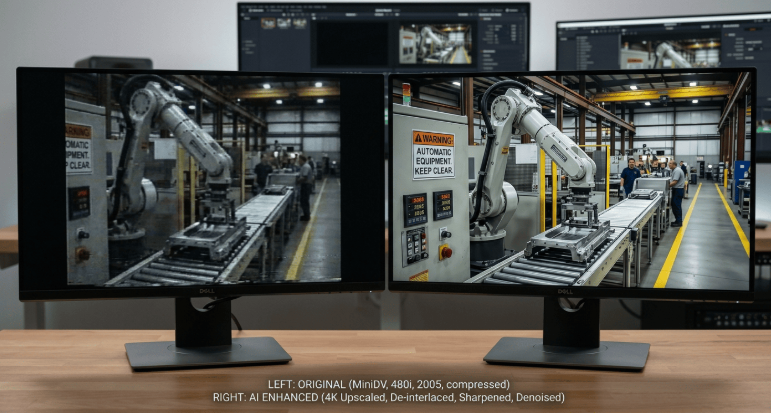
Somewhere on a drive in most manufacturing units there is a factory tour nobody has watched in years.
It was filmed for a reason. A buyer visit that was arranged and then cancelled. A website built in a hurry. A CD that went into a folder handed out at a trade fair. An inauguration, a certification, a delegation that came and went.
It shows the line running, the machines working, people at their stations, the material moving from one end to the other. Then it was archived and the technology around it moved on, and now it looks like what it is, which is video from a decade ago.
An AI Video Upscaler with practical enhancement workflows through Higgsfield can bring most of that material back to a usable standard, and for a plant that cannot easily be filmed again, that matters considerably more than it would for almost any other kind of footage.
What footage does a unit already own?
More than the office remembers, and it is usually in several places at once.
A factory tour or capability film, commissioned at some point for a website, an exhibition or a buyer.
Process footage, shot by somebody to document a method, a changeover or a fault, frequently on a phone and frequently better than anything commissioned.
Machinery running, filmed at installation or during commissioning, which suppliers often provide and units rarely keep track of.
Event material from an inauguration, an audit, a delegation visit or a trade fair stand.
And product footage, filmed for a listing or a catalogue and then left where it was made.
None of it was archived deliberately. It accumulated, which is why it takes an afternoon to find and why nobody knows what is there until they look.
Why can a plant rarely be filmed again?
Because filming inside a working unit is disruptive in ways that are easy to underestimate.
Production does not pause conveniently. Shooting a tour properly means either working around a running line, which produces compromised footage, or stopping it, which costs output.
Access is controlled for good reasons. Safety inductions, restricted areas, protective equipment, insurance. A crew inside a plant is a managed situation rather than a simple booking.
Buyers and clients complicate it. Work in progress on the floor frequently belongs to somebody, and filming it without permission is a problem with a customer rather than with a camera.
And the plant itself changes. Lines get reconfigured, machines get replaced, processes get automated. Footage from four years ago documents an arrangement that may no longer exist, which is precisely why it is worth something.
That last point is the one that decides this. A photograph can be retaken. A specific configuration of a specific line on a specific day cannot.
What did the older formats do to it?
Reduced it considerably, and for reasons that were sensible at the time.
Footage shot before the last few years was captured at resolutions that seemed generous then. Displays have moved on, and material that looked sharp on a monitor in its day looks soft on anything current.
Then it was compressed for delivery. Video destined for a CD, an early website or an email attachment was encoded down hard, because bandwidth and storage were the constraints. Details were discarded permanently at that stage.
Older cameras produced more noise, particularly under the mixed lighting typical of an industrial building, and the noise reduction applied in-camera smoothed away fine detail while removing it.
And the aspect ratio may be wrong. Material from far enough back is narrower than current displays expect, so it sits in a frame with bars either side.
None of that reflects the plant. The line was running properly and the camera recorded what it could, which is the situation an AI Video Upscaler is built to improve.
Which buyers actually ask to see the facility?
More than used to, and the expectation has hardened considerably in recent years.
Export buyers assessing a new supplier want to see the premises before committing, and travelling to do so is expensive enough that a video is frequently accepted in place of a first visit.
Larger domestic customers conducting supplier evaluation ask for the same, usually as part of a broader qualification process.
Auditors and certification bodies increasingly accept or request visual evidence as part of remote assessment.
And financial and institutional counterparties occasionally want to see that the operation described on paper exists in the form described.
The common thread is that these requests arrive with a deadline. Somebody wants the material this week, which means whatever exists in the archive is what will be sent. Having it in a usable state before the request arrives is the entire point.
How far can an AI Video Upscaler take a file from a decade ago?
Considerably further than most people expect, because the damage is systematic rather than random.
Compression artefacts respond best of all. Blocking and banding follow predictable patterns produced by known encoders, and an AI Video Upscaler reconstructs them more convincingly than it handles anything unpredictable.
AI Video Upscaler resolution recovery brings a file back to a standard that holds up on a current display rather than only on a phone.
Noise reduction from an AI Video Upscaler on material shot under industrial lighting, which is where older cameras struggled most.
Frame rate smoothing where the original was captured low or inconsistently, which an AI Video Upscaler handles alongside the rest.
And consistency across a mixed set, which matters when footage from three different years is being cut into one piece.
What it does not do is change what was filmed. The framing, the composition and whatever was or was not in shot remain exactly as recorded, which is the right limit and the subject of the next two sections.
What should be checked before any of it is published?
Four things, and the second one is the most important.
The date. Footage showing a plant as it was must be labelled as such. A buyer assessing current capacity from material filmed six years ago is being misled, even where nobody intended it. A visible date solves this entirely and costs nothing.
Safety and compliance practice visible in the frame. This deserves real attention. Standards have tightened, and footage from some years ago may show working practices that would not pass a current audit. Protective equipment, guarding, handling, housekeeping. An export buyer evaluating a supplier is frequently assessing exactly these things, and publishing old material showing practice that has since improved creates a problem rather than solving one.
Whose work is on the floor. Work in progress visible in old footage may belong to a customer, and identifiable products from a client relationship should not appear without permission.
And people in the frame. Employees who appeared in a film years ago may no longer work there, and it is worth a thought about whether they should still be visible in published material.
Which footage is better left in the archive?
Anything that shows something no longer true.
A process since replaced. If a line has been automated or a method changed, footage of the old way misrepresents the current operation regardless of how good it looks.
A facility altered. Extensions, reconfigurations and relocations all mean the plant in the footage is not the plant a buyer would visit.
Anything showing practice that has improved. Covered above, and it bears repeating because the instinct is to use the best-looking footage rather than the most representative.
And material where the quality gap is simply too wide. An AI Video Upscaler improves a great deal and does not perform miracles on something captured very badly to begin with.
The useful framing is that recovered footage is historical material, valuable for showing where an operation came from, and current footage is what demonstrates what it does now. Both have a place and they are not interchangeable.
What does the same archive do for recruitment and finance?
Two purposes beyond the buyer, and both are easier to serve once the material exists.
Hiring is the first. Manufacturing units across Gujarat compete for skilled operators, technicians and engineers, and a candidate deciding between two offers has almost no way of knowing what either floor is actually like. Recovered footage showing the plant, the machinery and the conditions answers that better than any description in a listing.
It also reaches families. A great many hiring decisions in this sector involve somebody’s parents, and a film showing a clean, organised, modern operation does work that a job advertisement cannot.
Institutional conversations are the second. Lenders, investors and joint venture partners assessing an operation want to see it, and the same qualification the article has already described applies. Material that exists and is ready is worth considerably more than material that could be produced in a fortnight.
The practical point is that one processing session serves all three audiences. An AI Video Upscaler pass across the archive produces the buyer film, the recruitment material and the institutional presentation from the same source, and Higgsfield keeping them organised by purpose is what stops the same work being redone each time somebody asks.
And each audience wants a different length, which is an export rather than a new production once the material is in order.
How does a workspace handle a set of mixed vintage?
By processing it together rather than file by file, which is where most of the practical benefit sits.
Higgsfield is an AI creative suite, meaning the processing, the trimming and the export happen in one place rather than requiring software installed on an office machine for a job done once a year.
Batch handling is the main argument. An archive is dozens of files, and an AI Video Upscaler should take each group at once, and grouping them by source and camera rather than by date is what makes a single treatment work across each group.
Consistency across vintages is the outcome that matters. Footage from three different years cut into one capability film otherwise announces its own age at every join, and bringing it to a common standard is what allows old and recent material to sit together.
Higgsfield keeping originals untouched matters here more than in most applications, since the unprocessed file is the record and the processed one is a presentation of it.
Higgsfield format variants from each recovered file, since the same material serves a website, an email to a buyer, a trade fair screen and a presentation.
And browser access, which suits a unit where this happens on whatever computer the office has rather than on a provisioned workstation.
What belongs alongside the recovered material?
Something current, and this is what turns an archive exercise into something useful.
A short piece of new footage filmed on a phone, showing the plant as it is now. Even a few minutes of unedited material provides the contemporary anchor that recovered footage needs.
Dates on both, so a viewer understands what they are seeing and when.
Current certifications and specifications in whatever accompanies the video, since the footage shows the facility and the paperwork shows the standard.
And a plain explanation of what changed, if the plant has been expanded or upgraded since. That is a strength rather than something to conceal, and stating it turns old footage from a liability into evidence of growth.
Where does an afternoon of this lead?
To a library that answers the next buyer request without a scramble.
Find everything first. Drives, old laptops, the CD in the drawer, whatever the previous website used, files somebody sent on a messaging app. This takes longer than expected and everything depends on it.
Watch it once and mark what is usable, against the checks above rather than against how good it looks.
Group by source and camera, then process each group through an AI Video Upscaler with a consistent treatment.
Label everything with its date at the point of processing, so nobody has to reconstruct it later.
Cut one short capability piece in Higgsfield, combining the best recovered material with a few minutes of current footage.
And store it somewhere the sales side can reach, because the value of this work is entirely in it being available when somebody asks.
Conclusion
A manufacturing unit can rephotograph a product any afternoon. It cannot re-film a line as it ran in a particular year, with that configuration, that process and those people, and that is what makes the archive worth opening.
An AI Video Upscaler handles the compression, the resolution and the noise that the formats of the time imposed, and Higgsfield processes a mixed set together so footage from three different years cuts into one piece.
Date everything. Check what the frame shows about how the plant worked then. And put a few minutes of current footage beside it, because the archive proves where the operation came from and only today’s material proves what it does now.
Recent Stories
- Gujarat Delegation Holds Textile Roundtable in South Korea, Invites Investment in PM MITRA Park
- Ahmedabad Town Hall to get a modern makeover; renovation to be completed in two years
- AMC to use rapid testing kits to check food quality at Diwali sweet and farsan stalls
- AMC to host special Garba at Kankaria Lakefront on Oct 24
- GSRTC to operate 2,400 extra buses for Diwali, plan over 8,000 additional trips
- Ahmedabad Book Fair 2026: Stalls More Than Double to 700+, New Attractions Added