
“Gujarat Governor has no right to continue even for one minute”:Excerpts of Arun Jaitley’s speech in Rajya Sabha
August 30, 2011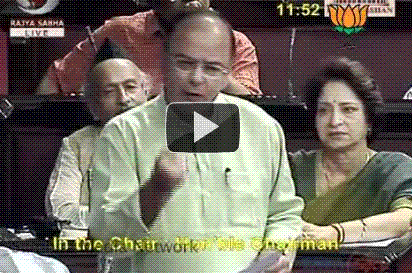
New Delhi, 30 August 2011
 Leader of opposition in Rajya Sabha and Gujarat MP Shri Arun Jaitley today demanded recall of Gujarat Governor Dr. Kamla Beniwal for her alleged misconduct of acting against the constitution. Following are excerpts of Shri Jaitley’s speech in Rajya Sabha in this regard:
“Chairman, Sir, I had given a notice in the morning seeking your indulgence to raise a matter which has an important bearing on our system of governance and the federal polity of India. The issue is precisely this: that a Governor is appointed in a State under article 155 of the Constitution by the President of India ostensibly on the aid and advice of the Council of Ministers.”
“In our scheme of governance, except very exceptional subjects, some of which have now been defined, under article 163 of the Constitution, a Governor is bound to act on the aid and advice of the Council of Ministers in the State and not otherwise. We have now a situation in the State of Gujarat where the Governor of the State has appointed a Lokayukta without the consultation or the aid and advice of the Council of Ministers. This is directly an infringement of article 163.”
“If this kind of a situation is to be permitted in the country, what would be the effect? The Governor is appointed by the Government in power at the Centre. If the Governor, in turn, starts making appointments in the State without the consultation of the elected Government of the State, effectively, the Central Government will then be interfering in the appointments of this kind which are being made in the State and not in accordance with the procedures mentioned therein.
“If we see the entire background of this issue, it has been a controversy which has been going on for five years. The year 2006 was when a State Government… ”
“May I straightway mention under the Rules and Procedures of this House, and I am quoting here the edition of Kaul and Shakdher, and this refers to rulings of this House? I am just reading out two paragraphs for the benefit of the House and for the hon. Chair. This is at page 1055 of the latest edition of Kaul and Shakdher. I quote, “When can the conduct of a Governor be discussed in this House? Where he takes a decision independent of his Council of Ministers or where he acts as a Chief Executive of a State under President Rule, his actions are subject to scrutiny of Parliament”. It is a case where the Governor has acted independent of the aid and advice of the Council of Ministers, and, therefore, hon. Chairman, Sir, you will have to permit me to put entirely the background of the facts because it entirely shows the mala fide of the conduct.”
“In 2006, a recommendation is made in consultation with the Leader of the Opposition, in consultation with the Chief Justice of India. The then Governor withholds the recommendation for a period of three years. Till 2009, the appointment is not done. Are we going to allow governance of this kind, and, then, gag the House and say that this cannot be discussed? After 2009, the facts must be placed because it is the grossest violation of the Constitutional provisions.”
“The biggest convention is the Constitution of India. There is no higher convention than a Governor being bound by the aid and advice of the Council of Ministers. If we are going to allow a situation, where Governors act independent of the aid and advice of the Council of Ministers, you are going to destroy completely the federal structure of Indian democracy.”
“In the year 2006, the State Government Council of Ministers, after consultation with the Chief Justice and the Opposition Leader, recommended the name of a retired judge, Justice Vyas.”
” This is how we are treating our States. From 2006 to 2009, the Raj Bhavan did not notify the appointment.”
“In 2009, the Judge recommended is appointed as a member or Chairperson of a Human Rights Commission in Maharashtra, a Congress-ruled State and the State Government is told, ‘you recommended a man three years ago. Now, he is no longer available’. So, after three years, they were asked to nominate another person. The State Government accordingly requested the Chief Justice. The Chief Justice gave a panel of four names. The State Government ticked one name out of that panel, that of Justice Vohra, recommended it to the Governor, consulted the Opposition Leader. At this stage, the party in Opposition took a stand that the Chief Minister has no locus standi; the Opposition Leader will not attend a single meeting of the Chief Minister, and five meetings were abstained by the Opposition Leader.”
“Five efforts are made in five meetings and finally the name is recommended to the Governor. The Governor peruses the file and this time for some reason — and there is something more than what meets the eye — the Chief Justice says, ‘I have appointed Justice Vora.’ Now he is the Chairman of the Judicial Academy. This gentleman is also no longer available. They then recommend a third name who withdraws his name. He is Justice Dave. Now comes the last stage when without consulting the Chief Minister for some reason — and when we are speaking in terms of norms of judicial accountability, it is examples of this kind that I have in mind — the
Chief Justice suo motu announces and writes a letter saying, ‘One Justice Mehta is now recommended by me.’ The State overnment says, ‘We have not come to you for consultation.’ He said, ‘I am recommending suo motu.’ The Opposition Leader in the Assembly says, ‘I give my consent to that name.’”
“The Chief Minister points out that from 2002 till 2011, this gentleman has campaigned on the following issues against the Chief Minister and the State Government so much so he’s present in rallies which have a quasi political character. How can you appoint such a person? While this correspondence is on, the Governor without consulting the Chief Minister, without the aid and advice of the Chief Minister or the Council of Ministers, makes and notifies the appointment of Mr. Mehta.”
” This is the case under Article 163 of the Constitution. We are Council of States. Therefore, protecting the rights of the States is part of our obligation. It says that there shall be a Council of Ministers with the Chief Minister at the head to aid and advice the Governor in the exercise of his functions, except those relating to whom to invite to form a Government or whether the Chief Minister has lost the majority or otherwise.”
” This is the case and Gujarat is a textbook example for every State that if the Central Government succeeds in this attempt that through the Governor they will start appointing Lokayuktas and making appointments, this will be repeated in every State.”
“Now the word that they are exploiting is the Gujarat Act says that the ‘Governor’ will notify the appointment. The word ‘Governor’ necessarily means ‘on the aid and advice of the Council of Ministers.’ A Governor, under Article 155, is appointed by the Centre on the aid and advice of the Council of Ministers.”
“Are we going to allow a situation in which the political party in power will start running and administering the States through the Governor and, in the matters, which fall completely within the jurisdiction of the State and the State Council of Ministers, the Governor will act directly? If a Lokayukta, which is appointed with these kinds of mala fides, starts giving reports with political motivations, what is going to be the credibility and worth of such reports? This constitutional crisis, we understand, has been created at the behest of people in power in New Delhi, so that you are able to use Raj Bhavans to make appointments of this kind. “
“We are the Council of States. A Governor, who acts in such an unconstitutional manner, has no right to continue even for one minute. Therefore, this House must seriously discuss a substantive motion, which we will bring for the recall of such a Governor, so that the constitutional provisions can be complied with.”
Recent Stories
- LG Hospital in Ahmedabad gets new mortuary with 18 cold storage units
- ACB Gujarat nabs one for seeking ₹4.07 lakh bribe for PMAY house allotment
- In-Charge Chief Fire Officer of Gandhinagar Nabbed by Gujarat ACB in Bribery Trap
- Gandhinagar Municipal Corporation Election 2026 Schedule Announced
- Reliance Foundation Hands Over 25 Electric Buses to Tirumala Tirupati Devasthanams
- Union Cabinet approves hike in EPFO wage ceiling to Rs 25,000