
Centre reiterates Govt commitment to preserve Parsi heritage and address demographic concerns
May 09, 2026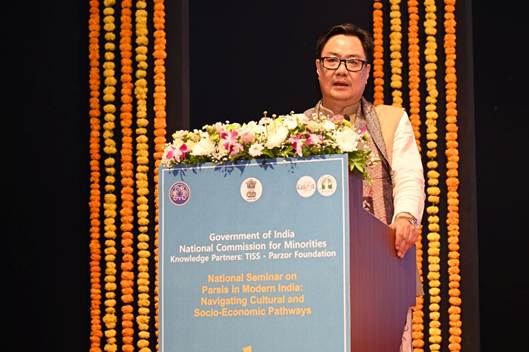
Mumbai: The National Commission for Minorities (NCM) organised a National Seminar on “Parsis in Modern India: Navigating Cultural and Socio-Economic Pathways” at the Yashwantrao Chavan Centre, Mumbai today. The seminar is part of the Commission’s series of academic engagements initiated in February 2026 to deliberate upon the concurrent status of minority communities.
The seminar brought together Union and State Ministers, policymakers, scholars, industrialists, academicians and representatives of the Parsi community to discuss cultural preservation, demographic concerns and the socio-economic status of Parsis in contemporary India.
In his keynote address, Shri Kiren Rijiju, Union Minister for Parliamentary Affairs and Minority Affairs, emphasized the enduring contribution of the Parsi community to India’s growth and development. He stated that the Government remains committed to preserve the community’s heritage and socio-economic welfare.
The Union Minister elaborated the Government’s efforts towards rejuvenation of the Avestan language and measures to address the issue of declining Parsi population. He lauded the achievements of the Parsi community, recalling how the Tata family sponsored India’s 1920 Olympic teams and how Parsis fielded the first Indian cricket team in the 1880s. He also praised the community’s immense contribution in building India’s industrial and economic foundations.
“It is not just about numbers; it is the impact that matters. The Government values every community and follows the dictum of Hon’ble Prime Minister Shri Narendra Modi, ‘Sabka Saath, Sabka Vikas’, which, in the third term, has been further strengthened with ‘Sabka Vishwas’ and ‘Sabka Prayas’,” Shri Rijiju said. He also invited suggestions from the community that would emerge from the day-long seminar, including on the Jiyo Parsi scheme.
Shri George Kurian, Union Minister of State for Minority Affairs, said, “It is important to recognize that the community today faces distinct challenges, particularly with regard to demographic sustainability. Recent discussions at the national level have drawn attention to concerns such as declining population trends and changing social patterns. These are complex issues that call for a thoughtful and coordinated response, involving both policy support and active community participation.”
Delivering the welcome address, Smt. Alka Upadhyaya, Secretary, National Commission for Minorities, highlighted the invaluable contribution of the Parsi community to nation-building and underlined the importance of preserving India’s pluralistic cultural ethos. She said, “Over the years, the Commission has remained engaged with issues concerning the Parsi community, including demographic challenges, preservation of cultural heritage and access to welfare schemes. These efforts are guided by sensitivity and a clear understanding of the community’s unique identity.”
Shri Berjis Desai, Member, NCM, spoke extensively on the extraordinary contribution of the Parsi community to India’s nation-building journey, underscoring how a numerically small community had played a disproportionately significant role in shaping the country’s economic, industrial, legal and philanthropic foundations. He remarked that the Parsi ethos of hard work, integrity, and public service had enabled the community to contribute meaningfully to the making of modern India.
Ms. S. Munawari Begum, Member, NCM, highlighted the importance of sustained and collaborative efforts towards safeguarding the cultural identity and demographic future of the Parsi community. She noted that the declining population of Parsis presents a matter of concern and requires collective attention from the Government, community institutions, civil society and scholars.
A short film showcasing the history, heritage and contribution of the Parsi community to India’s social, industrial and philanthropic development was screened on the occasion.
Shri Hormazd Godrej from Godrej Agrovet Ltd. highlighted the entrepreneurial and philanthropic traditions of the community and stressed the need to preserve its unique cultural identity for future generations.
Shri Pyare Jiya Khan, Chairman, State Minorities Commission, Maharashtra, spoke about the contribution of Parsis in Maharashtra and the need for sustained institutional support for minority communities.
During the event, a Coffee Table Book on the Parsi community’s legacy, achievements and demographics was unveiled by the dignitaries.
Dr. Atya Nand, Joint Secretary, NCM, informed that a compendium with reference to Jainism, Buddhism and Parsis will be launched on 19th May, 2026 at New Delhi during the State Minority Commissions Conference.
Technical Sessions
Session 1: Cultural Identity and Preservation among Parsis in Modern India
The discussion focused on tangible and intangible heritage of the Parsi community, with deliberations on preservation of its rich cultural traditions, history, language, and identity. Shri Kerman Fatakia highlighted the historical significance of the F.T. Alpaiwalla Museum and acknowledged Government support for its upgradation. Ms. Tinaz Nooshian spotlighted the Parsi chapter in Gujarat’s textile traditions including Tanchoi, Surti Ghat Nu Kapdu, and BAFTA textiles. Dr. Meher Mistry provided a historical overview of Parsis as architects of modern India and their role in industrialisation and philanthropy. Shri Kerman Daruwalla shared insights on the TISS Parzor Online Certificate Programme and emphasized preservation of Avesta and Pahlavi languages.
Session 2: Socio-economic Status and Challenges of Parsis in Contemporary India
The session concluded that the way forward lies in a balanced approach — preserving identity while adapting to contemporary realities, strengthening internal support systems while engaging with broader national frameworks. Speakers including Shri Dinshaw Tamboly, Prof. Shalini Bharat, Ms. Pearl Mistry and Prof. Nasreen Rustomfram noted that Parsis, though numerically small, have contributed disproportionately to India’s economic development, industry, philanthropy and public life, yet today stand at a demographic crossroad marked by declining population, shifting family structures, and emerging socio-economic realities. Both sessions were moderated by Shri Yazdi Tatra.
Related Stories
Dandi Heritage Route, Parsi Circuit, Other roads to be upgraded under ₹1,185 crore projects in South Gujarat
Surat-Navsari Highway 4-Laning: Parsis oppose NHAI plan to acquire Doongerwadi Land
Rasna Group, Partners Celebrate Parsi Heritage and Community Service in Ahmedabad
Wake Up Gadkari: Perilous Highway Conditions Force Parsis to Halt Pilgrimage to Sacred Udvada Shrine
Recent Stories
- 319 Pakistani Hindus Given Indian Citizenship Certificates in Rajkot
- Gujarat to Get Four New Medical Colleges
- Navratri 2026 Live Day 5: Falguni Pathak Garba, Atul Purohit at United Way, LVP Vadodara & More
- AMC seals Fadiyu Garba venue over ₹39 lakh in unpaid rent, deposit
- Gujarat OKays 18 Advanced Cataract Surgery Machines Worth ₹8.85 Crore for Govt Hospitals
- Full Meals for ₹5: Gujarat Govt to Open 101 New Annapurna Centres for Labourers