
17th National Children Science Congress ends in Ahmedabad
December 31, 2009
17th National Children Science Congress ends in Ahmedabad
By our correspondent
Ahmedabad, DeshGujarat, 31 December, 2009
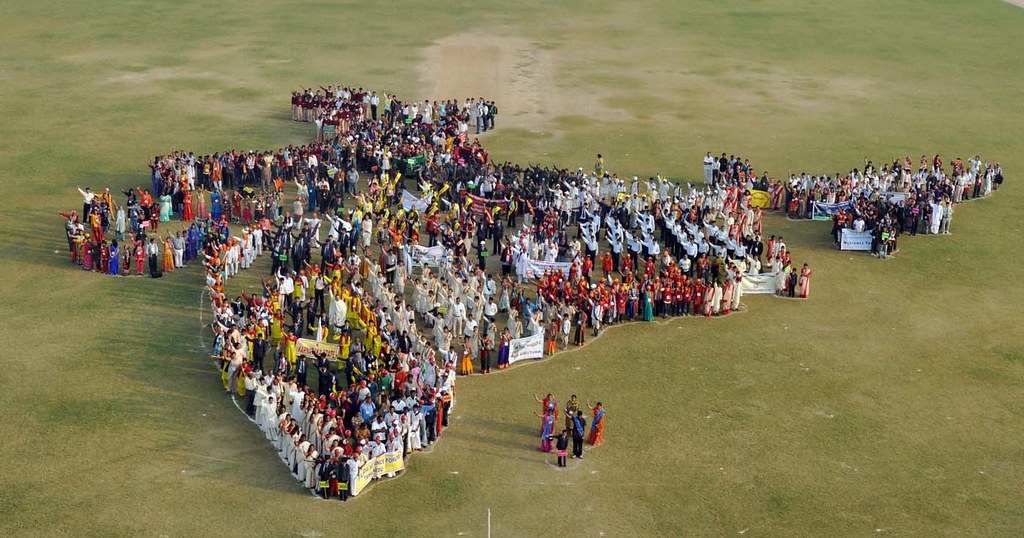
The 17th National Children’s Science Congress (NCSC), organized at the Gujarat Science City and SGVP International School, Ahmedabad, concluded on Thursday with 25 student projects identified for the further research. Total number of projects presented during the congress, held for the first time in Gujarat, was 560 and according to evaluators, the quality of projects has improved significantly. The final day of the event began with a rally of participating child scientists at the SGVP campus. While chanting the slogan – “Jay Jawan, Jay Kissan, Jay Vigyan” the participants, dressed in traditional outfits peculiar to their respective states, resembled the ‘United Colors of India’ by depicting the map of India in the central ground of the campus.
In other significant development, Gujarat Council of Science City, which successfully hosted the 17th NCSC, has been enrolled as one of the partner to promote the year 2010 as ‘The International Year of Biodiversity’ by United Nations, at international level along with some other institutions like UNEP, UNESCO and UNDP. “The United Nations has declared 2010 to be the International Year of Biodiversity. It is a celebration of life on earth and of the value of biodiversity for our lives. The world is invited to take action in
2010 to safeguard the variety of life on earth: biodiversity. Gujarat Science City (GSC), working under the aegis of the Department of
Science & Technology, Government of Gujarat, is emerging as a large-scale science popularization platform in the state and country
to promote innovative and experimental activities through hands-on and minds-on exposures” informed Shri Ravi Saxena, Principal Secretary, DST, Government of Gujarat and Chairman, 17th NCSC Steering Committee, The interesting aspect of the 17th NCSC was the fact that it has seen greater participation from female students. Similarly, projects from rural area were far ahead of their peers from urban areas, as far as originality is concerned. Out of total 560 projects, 289 presentations were made by female students. In case of 236 projects undertaken by students from rural areas, 123 were presented by girl students. In urban area too, the number of female students – 166 was also higher than that of male students, which stood at 158.
Out of total 560 projects, the evaluators selected 25 projects for further research. Three projects were selected from Andhra Pradesh, Kerala and West Bengal each, while Assam, Maharashtra and Tamil Nadu were the states, from where 2 projects each were selected for the purpose. Other states from where one project was identified include Arunachal Pradesh, Bihar, Himachal Pradesh, Karnataka, Manipur, Meghalaya, Odisha, Puducherry, Tripura and Uttar Pradesh. Projects from Gujarat were nowhere in the list, but according to official announcement, the identification was made while keeping in mind certain factors such as availability of infrastructural and logistics support required for the further research and therefore non-inclusion of any projects doesn’t mean that the projects was not capable for qualifying.
All the 32 participating states were divided into three categories namely tiny-small-medium, medium- big and very big-giant states in
order to acknowledge their contribution and Tripura, Kerala and Andhra Pradesh were adjudged as the best performer state respectively.
While giving details about the 17th NCSC, Dr. Jaideep Barua, Chairman, Academic Council, said, “Total 560 projects were presented by students from 32 states and 43 evaluators were roped in for the rating of the projects. Participation from almost every states of the country indicates that the NCSC, a movement for scientific popularization, has successfully expanded its reach. More importantly, the quality of the projects has also witnessed significant improvement.”
He also informed that the considering the higher participation, the number of technical sessions held parallel had been increased this
year to 12 against 10 in the conclave held last year. Apart from that, the two exhibitions, 18 activity corners and workshops for teachers also found a great favor from the participants.
Dr. Narendra K. Sehgal, former advisor to DST, Government of India and Head, NCSTC, who has played a pioneering role in the initial stage to make the NCSC a great success, said, “The extent of participation in the 17th NCSC indicates that the movement has come of age, as total number of projects competed for inclusion in the 17th NCSC is as high as 50,000. But, considering the total number of schools in India, it seems that still there is a room for higher participation. Higher participation will ensure better quality of projects and it will also make the task of the evaluators most difficult. So to make this possible, all of us should work hard to create awareness about the event.”
In his address, Shri Ravi Saxena, Principal Secretary, DST, Government of Gujarat and Convener, 17th NCSC, said, “The 17th NCSC, organized for the first time in Gujarat, has opened new vistas for the students, who want to pursue career in the filed of scientific research. But at the same time, we need to create more awareness about the event for the more inclusive development.”
🗃️ This story is from our archives and may contain outdated information.
Recent Stories
- Ahmedabad Civic Body Plans Key Road-Widening Project in Raipur
- AMC to Lay New Eastern Trunkline in Next Two Years to Tackle Waterlogging
- Ahmedabad Civic Body to Procure 104-Metre Fire Crane; Revises Charges for Outstation Fire Calls
- AMC Imposes ₹50 Lakh Penalty on Naroda Flyover Contractor for Delay
- Ahmedabad Firm Accused of ₹41.44 Crore Bank Fraud; Three Partners Booked
- AMC Monsoon Control Room 2026 Helpline Numbers Declared