
India-China can make Asia centrestage of world economy:Modi
November 09, 2011

Ahmedabad, 9 November, 2011
Bullish on future of India-China relations, Gujarat Chief Minister Narendra Modi today said both countries will make Asia the centrestage of the world economy.
He said that the 21st Century belongs to India and China and the two emerging and strong Asian nations have the need and tremendous potentials to dominate the global economy.
Narendra Modi speaking at a Gujarat investment meeting in Beijing’s five-star hotel under the title “Business and Investment Opportunities in Gujarat” also said that China and its people have a spacious place in his heart. Top functionaries of about 180 companies were part of this business Meet in Beijing.
Modi admired hard working, disciplined and resilient nature of Chinese people in his speech and added that cultural bonds between China and India are very strong and deep-rooted.
“I have seen growing interest among Chinese companies to work in Gujarat. We wholeheartedly welcome them. My personal visit is to reinforce that process,” he said.
Modi also announced plans to open a Mandarin school to promote learning of Chinese language in Gujarat.
“To give a big boost to the economic interaction, we must emphasise on cultural exchange. I am keen to start a Mandarin language school. We also have a number of Buddhist places which can be the driver of cultural exchange. You may be happy to know that Gujarat has already emerged as a great tourist destination in the Asian region,” he said.
Talking about Gujarat’s contribution to Indian economy, he said that his state with a large pool of successful entrepreneurs has become the growth engine of India’s growth story, crossing new milestones with people’s participation.
Mr. Modi looked forward to open new vistas of tourism too, with several tourist sites in the state. He recalled that the ancient Buddhist pilgrim Huen-Tsang during his visit to India had stayed for maximum period in Gujarat. There are many Buddhist sites in the state.
Modi, in his speech, said while “India has emerged” is the buzz word all around the world, China’s emergence is already an established fact.
India and China are set to play a major role in global politics. “Already, it is being seen that during the time of Global recession, both India and China have given strength to the world economy,” he said.
He said the “demographic clock of history” is in favour of both countries which have a billion-plus population each.
“I have also been saying that it is the age of the power of the youth. These two countries have the youth power. India and China are both very ancient civilisations. But, more than ever before, the demographic clock of history is in their favour. We in India, firmly believe that our youth power will make our country emerge as a strong force not only in economic terms but in all the aspects of human life,” Modi said.
The meeting was organised by the Embassy of India in Beijing and the China Chamber of Commerce for Import and Export of Machinery and Electronic Products (CCCME).
Modi said he admires China’s work ethic and above all their sense of history.
Modi is on five-day visit to China with a business delegation of 23 members.
Speaking on the occasion, CCCME Vice-President Shi Yong Hong showed interest on behalf of the Chinese companies for cooperation with Gujarat in industrial, infrastructure, information communication technology and machinery manufacturing sectors.
Extending a warm welcome to delegation from Gujarat led by the Chief Minister, Indian Ambassador to China Dr Jayshankar said that a stable government and progressive policies have created an excellent atmosphere conducive for investment in Gujarat.
Gujarat’s Principal Industries Secretary Maheshwar Sahu, Gujarat Infrastructure Development Board (GIDB) CEO A.K. Sharma, China’s TBEA Shenyang Co Vice-President Lend Yong and Adani Power’s China CEO N.V. Ranade made presentations.
The Indian Ambassador had received Mr. Modi and members of the Gujarat delegation at the airport.
TBEA representative from Shenyang, in Liaoning province gave presentation on “Why TBEA has chosen Gujarat for their investment in India” in this event. It should be noted that prior to Modi’s China visit TBEA has committed Rs. 2,500-crore investment in Gujarat for a green energy project by signing MoU.
Narendra Modi meets Beijing Mayor
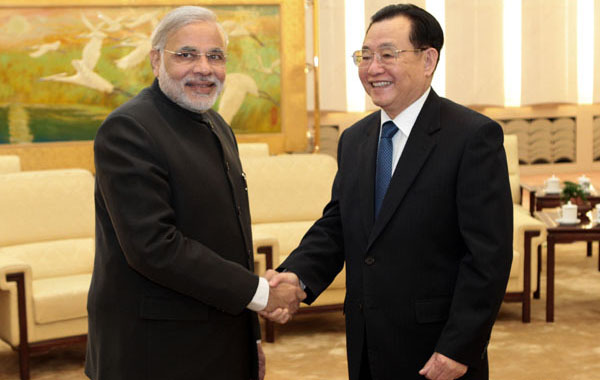
Later in the afternoon, the Chief Minister Modi along with the delegation met the Mayor of Beijing’s Municipal Government Guo Jin Long and discussed the scope of developing urban and environmental infrastructural facilities. He invited the Mayor to Gujarat also.
Mr. Modi gave details of new projects like New Port City, Clean and Green City, Twin City and ‘Rurban’ concept being undertaken in the most urbanized state of Gujarat, for efficient solid waste management, water treatment and other facilities, in the context of emergence of Beijing as world-class Local-Self Government Initiative.
Beijing’s Mayor also had a word of praise for the fast modernization of Gujarat and farsightedness of the Chief Minister, and thanked the Gujarat’s delegation for accepting the visit to China.
“As the biggest emerging nations, China and India face common challenges and share common responsibilities and extensive interests,” said Wang Gang, a member of the Political Bureau of the Central Committee of the Communist Party of China as he met in Beijing with Narendar Modi, chief minister of the western Indian state of Gujarat.
Wang, also Vice Chairman of the National Committee of the Chinese People’s Political Consultative Conference, said China attaches great importance to bilateral ties with India, adding that China is willing to make joint efforts with India to boost mutual trust and deepen reciprocal cooperation “at various levels and in various fields,” including sub-national cooperation, in order to advance the bilateral ties in a stable and healthy way.
During their meeting, Wang also hailed the development of bilateral relations over the past years, noting the communication and coordination between the two nations on major international issues.
In 2011, known as the Year of China-India Exchanges, the two sides held a series of activities to promote and bring substance to their strategic partnership of cooperation, he added.
Modi pledged more efforts to advance sub-national cooperation and actualize the great potential for cooperation between the two countries.
Recent Stories
- Voting for Gandhinagar Municipal Corporation (GMC) Election, various local by-polls this Sunday
- Gujarat Announces Comprehensive MSME Assistance Scheme Under Industrial Policy 2026
- India Could Be Among First Countries to Roll Out 6G: Jio
- Metro Train Services on PDEU - GIFT City Stretch Suffer Disruption; Train Operator and Controller Suspended
- 87 Jawans of BSF and CRPF Hospitalized Ahead of Statue of Unity Parade; 37 Under Treatment, 1 Death
- Gujarat Bets on Bio-Manufacturing to Strengthen Fertilizer Security Amid West Asia Crisis