
PM gives away award to Ahmedabad Mayor, Commissioner for BRTS
December 03, 2009
PM gives away award to Ahmedabad Mayor, Commissioner for BRTS
By our correspondent
Ahmedabad, DeshGujarat, 3 December, 2009

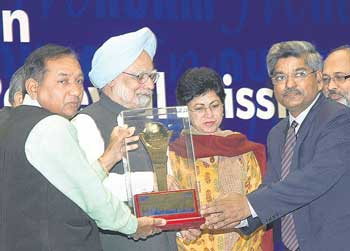 Hon’ble Prime Minister Shri Manmohan Singh gave away the prize to Mayor Ahmedabad Shri Kanaji Thakore and Municipal Commissioner, AMC Shri I. P. Gautam at a function organised today at Vigyan Bhavan in Delhi. The other dignitaries on the dias of Vigyan Bhavan were Kumari Selaja Minister for Housing and Poverty Alleviation, Dr. Montek Singh Ahluwalia Deputy Chairman Planning Commission, Govt of India and Dr. M. Ramchandran Secretary Ministry of Urban Development Govt.of India
The centre’s ministry of urban development (urban transport division) has chosen Janmarg – Ahmedabad BRTS project as the ‘Best Mass Transit Project’.Prime minister Manmohan Singh gave the prize to municipal commissioner IP Gautam and mayor Kanaji Thakore at a function organised in Delhi on Thursday.
Ahmedabad Janmarg Limited (AJL) had sent its entry to the centre after the BRTS was launched in Ahmedabad.Officials said all the mass transit systems including the Delhi Metro and BRTS in Delhi were in the race.
A special committee – urban development committee – was formed to judge the best mass transit system across country.AJL will receive a trophy and Rs4 lakh cash prize as part of the award. Within two months of its launch, the AJL has managed to get around 22,000 commuters for its BRT buses and earns around Rs 1.10 lakh per day.
Janmarg BRTS in Ahmedabad is one of the four awards that Gujarat bagged for various projects under the Jawaharlal Nehru National Renewal Mission (JNnURM). While Ahmedabad bagged one award in the mass transit system – Surat received three awards. Awards for Surat include – Best Performance City, Best Improvement in Financial Management and Pro Poor Performance in JNNURM.
About Janmarg BRTS
Janmarg- Ahmedabad Bus Rapid Transit System
The Ahmedabad transport strategy is people centric. It is focused on moving people and not traffic. We believe that all people, men and women, young and old, physically challenged should be able to move around in city with comfort. Efficiency, affordability, safety and security are central to the plan. To emphasize this, Hon’ble Chief Minister Shri Narendra Modi has named the system as ‘Janmarg’.
Janmarg, after a long trial, was dedicated to the people of Ahmedabad on 14th October, 2009. Janmarg is operating 18 buses on 12.5 kms of exclusive ROW, 20 bus stations and carry 23-25000 passengers per day. The ridership is likely to double with the connection to Kankaria lake due in December 2009. People of Ahmedabad have accepted the system and visitors have applauded the effort.
Since July 3, the system was on a trial mode running free of charge. About a million people have already taken a ride on the system. Experts, having seen the system and its plan have described it as:
* ‘already a BRT Best Practice (Dario Hidalgo http://www.embarq.org/en/node/1399)’,..
* ‘country’s first bus rapid transit system, could draw high end crowd (S.K. Lohiahttp://www.dnaindia.com/india/ report_historic-brt-could-draw-high-end crowd_1280826)’ and
* Ahmedabad on modernity bus, says BRTS pioneer (Enrique Penalosa-http:// www.dnaindia.com/india/ comment_ahmedabad-on-modernity-bus-says-brts-pioneer_1280614).
Janmarg Project, the peoples way, comprising of 88.8 Kms long network, spans through the city. Jan Marg connects the central city (Kalupur, ST, Astodia, Danapith) to outlying industrial areas (Naroda, Odhav), institutional (University) and residential areas (Bhopal, Chandkheda). The project is being undertaken in two phases and the first stretch of the phase-1 between RTO-Pirana covering a distance of 12.5 kms has been operationalised for public. In the central city, to cross congested network, we have planned a 4.5 kilometer elevated corridor which carries buses at elevated level from Cloth Market to Kalupur and Prem Darwaja and at the same level crosses the railway line to connect the BRT network to Naroda and Odhav. The bus stations are on the elevated corridor and will have direct connection to Railway station. Elevators/escalators will be used to facilitate movement of people from ground to first floor.
It may be noticed, the BRT is not only about creating infrastructure for buses, but also enhancing the quality of commuting for all users with dedicated bus lanes, cycle tracks, pedestrian facilities, personalised vehicles and optimum parking. Care has been taken to ensure that motorized traffic does not suffer after BRTS implementation. You also have benches to rest while walking. There are trees at intervals of 7/8 meters on both sides of the road planted which will shade the walk ways and bicycle lane.
There are 122 aesthetically designed and accessible bus stops. Ticketing will be off-board. Smart cards will let you through the turnstiles, like in rail system. Bus doors and bus stop doors will open/ close simultaneously. Passengers will get information about bus arrival, departure, door closure, etc., at the bus stops as well as on the bus. There will be common tickets with AMTS. AMC has taken extra care to ensure adequate lighting both in terms of average lux levels and uniformity over space. We will also put CCTV’s at bus stations, junctions and such other locations. With all these, moving around in Ahmedabad will be easier and safer.
A new culture of administration is being ushered by creating Ahmedabad Janmarg Ltd., a fully owned company of AMC, to manage BRTS. Private sector operators will purchase and operate buses. Janmarg pays them on kilometer basis. Janmarg t will recover costs through fare, advertisement and other sources. A parking plan along BRTS corridor has been worked out. It will be managed on a Pay-and-Park basis. EURO-III diesel buses are being used for operation. CNG buses will be considered in the next stage. We will also have AC buses introduced in due course of time.
ACCESSIBLE AHMEDABAD
The commercial capital of Gujarat, Ahmedabad is one of the emerging urban centers of India. the population of Ahmedabad is 5.5 million in the municipal area of 466 sq.kms, The population of the area is likely to rise to 6.5 million and to 11 Million by 2011 and 2035 respectively. The city then would include, in addition to Ahmedabad city, the capital city, Gandhinagar and several other towns and villages around it.
Gujarat state has a long and well established tradition of urban planning. There have been three plans. prepared in the form of Development Plans for Ahmedabad City. As a result, today the city relatively compact and is characterized by well-developed ring-radial network, mixed land use with fairly high density. This density gives better opportunity for services and infrastructure rather than a sprawl tendency. Motorisation rates are high. Today, there are about 20 lakh registered vehicles in the city. In terms of composition, accounting for 75% of the total vehicles, motorized 2 wheelers predominate. While the proportion of the four wheelers continues to be low, the sheer increase in their number of cars is beginning to create grid lock on the city roads.
Despite the high motorization, the benefit of compact city coupled with well balanced road network, are still being enjoyed by the people of Ahmedabad. For a city of 60 lakhs, congestion, both in terms of levels are spread is relatively low. Peak period is short and the speeds are well above minimum acceptable limits. Still the travel in Ahmedabad is relatively quick and safe (road fatalities are low at 240/year) as the trips are short (average of 5.5 kms) and distributed. Majority of road fatalities in Ahmedabad involves people on bicycles (42%), 2 wheelers (30% and pedestrians (19%). The responsible vehicles for fatalities are trucks (47%), Bus (12%) and 2 wheelers (13%). With introduction of BRT, better bicycle and pedestrian facilities and traffic management, the city targets to bring the fatality number below 100 in the next 3 years.
The city also has a long tradition of Public Transport Operations. The Ahmedabad Municipal Transport System (AMTS) operates buses since 1945. However, severe financial constraints had led to rapid decline in services reducing the transit patronization to 3.5 lakh footfalls Per day.
With the decline of public transport, the rikshaws (three wheelers), operating as an intermediary transit system, received a big push. In 2005, there were about 55000 three-wheelers plying on the city roads. Most of these were using adulterated fuel contributing to deterioration in the city air quality, especially with regard to the respiratory particulate matter (RSPM). In 2005, as per the National Ambient Air Quality monitoring data, the was 3rd most polluted city in the country.
A large proportion of the urban poor do not have access to reliable and affordable transportation, and as a result remain excluded from employment opportunities, health facilities and interaction with the rest of the community. Improving the quality of life in urban areas is expected to contribute to building a more equitable society.
Recognising the socio-demographic and economic reality, the Government of Gujarat, declared the year 2005 as Urban Development Year and initiated focused activities to develop infrastructure so that city’s role as an engine Gujarat economy is strengthened. The initiatives were realigned with JnNURM programme of the Government of India.
INTEGRATED TRANSPORTATION SYSTEM
As a way out of the grid lock, AMC has developed an integrated transit system plan being be implemented in phases. The components of the plan include network improvements, transit improvements and Traffic Management Initiatives. Roads have built to their full width. The city has added river bridges and ROB’s to complete the rings and radials. Flyovers are being built to resolve junction issues. Several of these projects are completed and opened for public use. AMTS fleet has been expanded from about 480 to 1000 buses through private participation. About 50000 CNG Rickshaws have been introduced while phasing out excessively polluting auto rickshaws. Further to this, AMC has operationalised ‘Janmarg – Ahmedabad BRTS’ . A sub-urban rail system and a metro system are also planned. The plan provides to have choices to the people for their mobility in terms of walking, bicycling, rickshaw, bus, BRT, sub-urban rail or metro.
It is a great honour to be receiving this award for Best Mass Transit Project. We thank the Government of India for recognizing the effort and this encourages us to do more.
🗃️ This story is from our archives and may contain outdated information.
Recent Stories
- Gujarat HC Gives Yusuf Pathan Four Weeks, Warns of Higher Damages in Vadodara Plot Case
- Viksit Gujarat Industrial Policy 2026 Unveiled; Aims to Make State Global Manufacturing Hub
- Jio Platforms Surges into Global Top 20 in latest WIPO Patents Ranking
- BJP MLA Darshna Deshmukh Walks Out of Party Event, Stages Dharna, Threatens Resignation
- Pakistani Juvenile Among 11 Who Escape Rajkot Observation Home; Six Still Absconding
- Bharuch Jama Masjid Row Escalates as Hindu, Jain Groups Hold Rally and Submit Petition